
For a professional barber brand, distributor or private label business, the blade assembly is one of the most important parts of a hair clipper. A clipper may have an attractive housing, a powerful motor and a long battery runtime, but inconsistent blade alignment or poor cutting performance can quickly affect customer satisfaction.
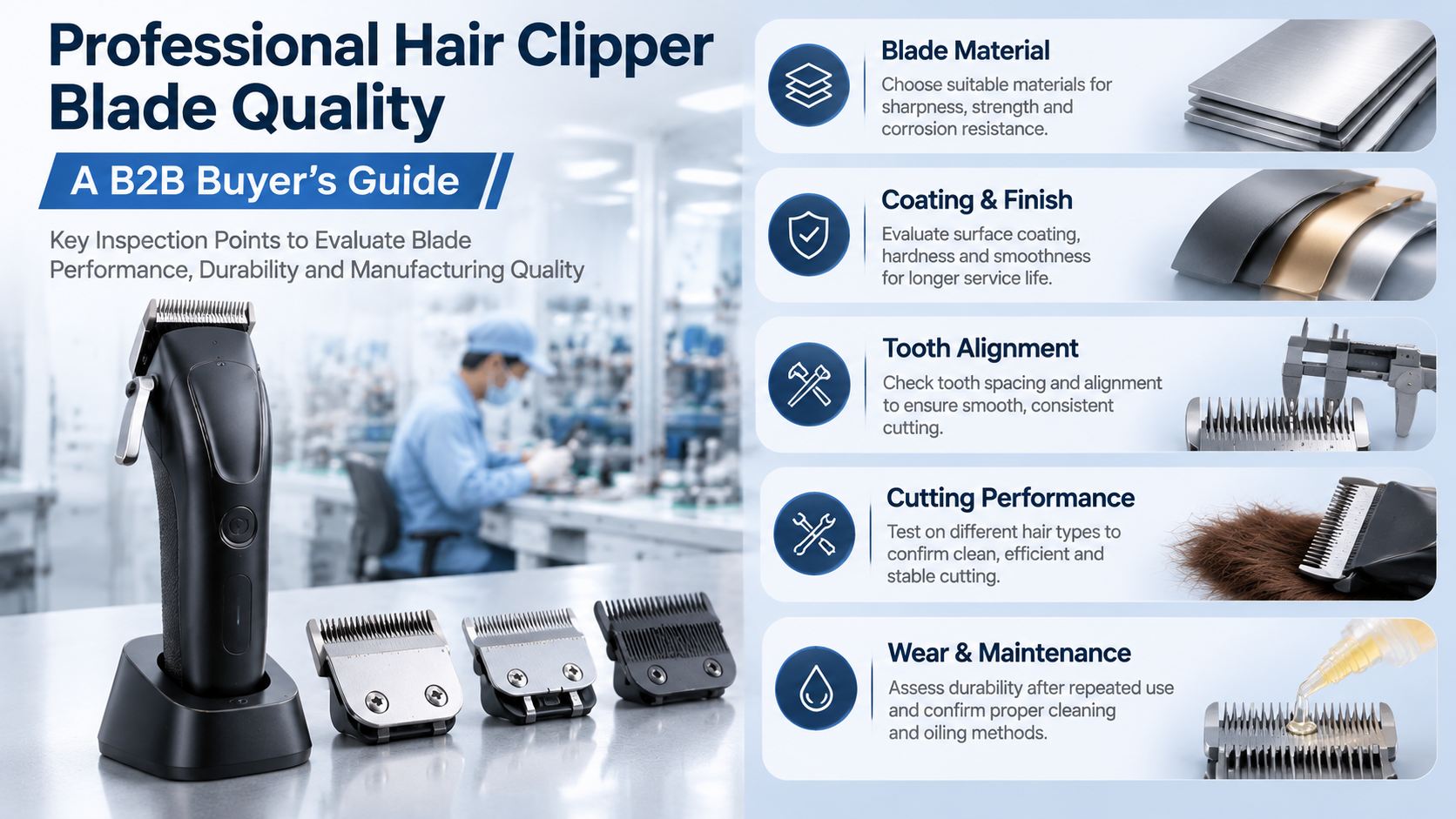
When sourcing from a professional hair clipper manufacturer, buyers should evaluate more than the blade material named in a product catalogue. The substrate, tooth geometry, surface finish, coating quality, alignment, heat behavior and maintenance requirements all contribute to the finished product experience.
This guide explains how B2B buyers can evaluate hair clipper blade quality, compare samples and establish practical quality requirements before mass production.
1. Understand the Complete Blade Assembly
A clipper blade is a working assembly, not simply a piece of metal. Depending on the design, it may include a stationary blade, a moving cutter, a blade spring or tension system, fasteners and an adjustment mechanism.
Before requesting a quotation, clarify the blade configuration and how it interacts with the clipper’s motor and drive mechanism. Ask the manufacturer for a drawing or specification that identifies the blade dimensions, tooth arrangement, adjustment range and compatible clipper platform.
For a private label project, confirm whether the blade assembly is an existing platform or a new design. Changes to tooth geometry, blade width or mounting points may affect tooling, compatibility and validation work.
2. Compare Blade Materials Carefully
Common clipper blade constructions may use stainless steel, ceramic components or metal blades with specialized surface coatings. These options should not be compared by name alone.
| Blade Construction | Potential Characteristics | What Buyers Should Verify |
|---|---|---|
| Stainless steel | Common metal blade option with a range of grades and finishes | Material grade, corrosion resistance, hardness and finishing quality |
| Ceramic cutting component | Used in selected blade designs and assemblies | Impact resistance, edge condition and compatibility with the moving blade |
| Coated metal blade | Uses a coating over a metal substrate | Substrate material, coating process, adhesion and wear performance |
| DLC-coated blade | Diamond-Like Carbon coating used in some premium blade designs | Coating specification, coverage, adhesion and performance after repeated use |
DLC describes a family of carbon-based coatings; it does not by itself define the substrate, coating thickness or final blade performance. Ask for the actual construction and supporting validation rather than relying on a coating name as a guarantee.
3. Inspect Tooth Geometry and Blade Alignment
Blade teeth must be manufactured and assembled consistently. Buyers should inspect tooth spacing, tooth tips, edge condition, parallelism and the alignment between the stationary and moving blades.
- Look for burrs, dents, uneven tips or visible machining defects.
- Check that the moving blade travels smoothly through its intended range.
- Confirm that the blade sits securely on the clipper body.
- Review the adjustment mechanism and the specified cutting-length range.
- Compare multiple samples rather than approving a single hand-selected unit.
Where dimensional tolerances matter, agree on the measurement points and acceptance limits with the manufacturer. A photograph is not a substitute for a controlled dimensional inspection.
4. Evaluate Cutting Performance With a Repeatable Test
A blade that looks sharp under magnification does not automatically deliver consistent cutting performance. The motor, blade geometry, moving-blade travel, assembly tension and test material all influence the result.
Ask the supplier to define a repeatable cutting test. The method should specify the test material or hair sample, clipper settings, blade condition, operating duration and the criteria used to judge pulling, snagging, missed sections or uneven cutting.
For a professional product, consider testing more than one hair type and density where practical. Record the results and compare production samples against the approved reference sample.
5. Check Heat, Friction and Vibration
During operation, the blade assembly experiences friction and vibration. Excessive heat or abnormal vibration may affect comfort, performance and the perceived quality of the clipper.
Evaluate the blade temperature after a defined operating period and under repeatable conditions. Record the operating setting, ambient conditions, lubrication state and test duration. Also listen for unusual noise and check for excessive vibration or movement.
Do not use a generic temperature limit without considering the complete product design and applicable safety requirements. Establish acceptance criteria with the engineering team for the specific model.
6. Review Coating and Surface Durability
For coated blades, inspect the surface before and after the agreed durability evaluation. Look for visible peeling, flaking, discoloration, corrosion or uneven coverage.
The validation plan should reflect the intended cleaning and maintenance routine. If the product instructions require blade oil, cleaning or drying after use, test and communicate those requirements clearly.
Ask the supplier to explain the coating process and what evidence is available for adhesion and wear resistance. Avoid assuming that a premium coating name means the blade is maintenance-free or will never wear.
7. Confirm Blade Maintenance and Replacement Support
Professional users need clear guidance on cleaning, lubrication, storage and blade replacement. The maintenance instructions should match the actual blade design and should not contradict the manufacturer’s recommendations.
For distributors and private label brands, confirm whether replacement blade assemblies are available, how they are identified and whether they are compatible with the relevant clipper models. Spare-part planning can be important for after-sales service and repeat business.
8. Build a Pre-Production Blade Quality Checklist
| Inspection Area | What to Check | Evidence to Keep |
|---|---|---|
| 素材 | Substrate, material grade and coating description | Approved specification and supplier records |
| Dimensions | Blade width, tooth spacing, mounting points and alignment | Inspection results against agreed tolerances |
| Surface | Finish, burrs, scratches, coating coverage and visible defects | Approved visual standard and inspection record |
| Cutting | Pulling, snagging, missed sections and consistency | Repeatable functional test results |
| Operation | Heat, noise, vibration and blade movement | Defined operating test record |
| Maintenance | Cleaning, lubrication and replacement instructions | Approved user manual and service information |
| Production | Sample consistency and change control | Golden sample and production inspection plan |
The buyer and manufacturer should agree which checks are performed on every unit and which are carried out by batch sampling. Destructive or endurance tests may require separate test samples.
9. Approve a Golden Sample Before Bulk Production
Once the blade assembly has passed the agreed evaluation, retain an approved golden sample and a written specification. The sample should represent the final blade, clipper body, motor configuration, adjustment mechanism and included accessories.
Record any approved deviations and define how changes to the blade material, coating supplier, tooth geometry, motor or assembly process will be reviewed. A change that appears minor can affect the performance of the complete clipper.
10. Questions to Ask a Hair Clipper Blade Manufacturer
- What is the blade substrate and, if applicable, the coating construction?
- Can you provide a blade drawing or dimensional specification?
- How do you inspect tooth alignment and edge condition?
- What repeatable cutting-performance test do you use?
- How do you evaluate heat, vibration and coating durability?
- Are replacement blade assemblies available for the selected model?
- How are material or process changes communicated and approved?
- Can we review the pre-production sample and quality inspection plan?
11. Discuss Private Label Hair Clipper Projects With Aikepro
Aikepro develops and manufactures hair styling appliances for overseas brands, wholesalers, importers and distributors. Its published product range includes rechargeable professional hair clippers with DLC-coated blade options.
For a private label or OEM/ODM project, buyers can discuss the intended market, blade configuration, product appearance, accessories, packaging and sample evaluation requirements with the Aikepro team. Exact specifications, customization feasibility, MOQ, lead time and available test documentation should be confirmed for the selected model.
Explore Aikepro’s rechargeable professional hair clipper with DLC blade or contact us for an OEM/ODM discussion.
よくある質問
Does a DLC-coated blade guarantee better cutting performance?
No. DLC is a coating category, not a complete performance specification. The substrate, coating quality, blade geometry, alignment and validation results all matter.
How can buyers check whether a clipper blade is sharp enough?
Use an agreed functional test with defined test material, operating conditions and acceptance criteria. Visual inspection alone cannot establish consistent cutting performance.
Do professional hair clipper blades need oil?
Maintenance depends on the blade design and manufacturer instructions. Buyers should ensure the user manual clearly explains the required cleaning and lubrication routine.
Can OEM buyers customize the blade?
Some projects can customize blade configuration, finish or other design details. Feasibility depends on the platform, tooling, engineering validation and order requirements.
What should be approved before mass production?
Approve the final specification, blade sample, functional test method, acceptance criteria, maintenance instructions and production change-control process.
Build a Reliable Professional Clipper Range With Aikepro
Blade quality should be evaluated as part of the complete clipper system. A clear specification, repeatable sample test and controlled production reference help buyers reduce sourcing uncertainty.
Contact Aikepro to discuss professional hair clipper samples, private label requirements and OEM/ODM manufacturing options.
Email: info@aikepro.ltd
WhatsApp: +86 198 7694 7310
Website: https://www.aikepro.ltd/