A power cord is easy to overlook when buyers compare a hair dryer’s motor, a straightener’s heating system or a multi-styler’s attachments. Yet the cord is part of the finished appliance’s everyday handling experience and electrical safety system. Repeated bending, twisting, pulling and movement near the housing can place stress on the cable, strain relief and internal termination.
For beauty brands, importers, wholesalers and distributors, hair styling tool cord durability testing should be included in product specification and sample approval. This is especially relevant when a product uses a 360-degree swivel connection or a flexible cord intended for frequent salon use.
This guide explains what OEM buyers should review, which tests may be relevant and how to agree on acceptance criteria with a manufacturer. The exact test method and limits must be selected for the specific appliance, cord construction and destination market.
1. Why Power Cord Design Matters
The cord connects the appliance to its electrical supply while users move, rotate and position the tool. Its construction needs to balance electrical ratings, flexibility, mechanical strength, heat exposure and normal handling.
A cord assembly may include the cable, plug, strain-relief boot, swivel or rotating connection, internal terminals and retention features. A weakness in one area can affect the whole assembly.
For OEM buyers, the key questions are:
- Is the cord rated for the finished product’s electrical requirements?
- Does the cable remain flexible under expected handling conditions?
- Is the housing exit designed to reduce excessive bending?
- Does a swivel feature rotate smoothly without stressing internal conductors?
- Are the cord, plug and internal termination controlled as approved components?
A product listing that says “360-degree swivel cord” does not explain the mechanism, durability or test conditions. Ask the supplier to describe the actual construction.
2. Understand the Difference Between Cord Flexing and Swivel Rotation
Cord flexing and swivel rotation are related but different mechanical actions.
Flexing or bending occurs when the cable repeatedly bends near the handle, housing exit or another point during use.
Swivel rotation occurs when a rotating joint allows the cord to turn relative to the appliance body. A swivel can reduce cord twisting during normal handling, but its performance depends on the contact design, retention, conductor routing and mechanical assembly.
Do not treat a swivel test as a substitute for a cord-flex test. If the product includes both features, evaluate both functions using methods appropriate to the design.
3. Inspect the Strain Relief at the Housing Exit
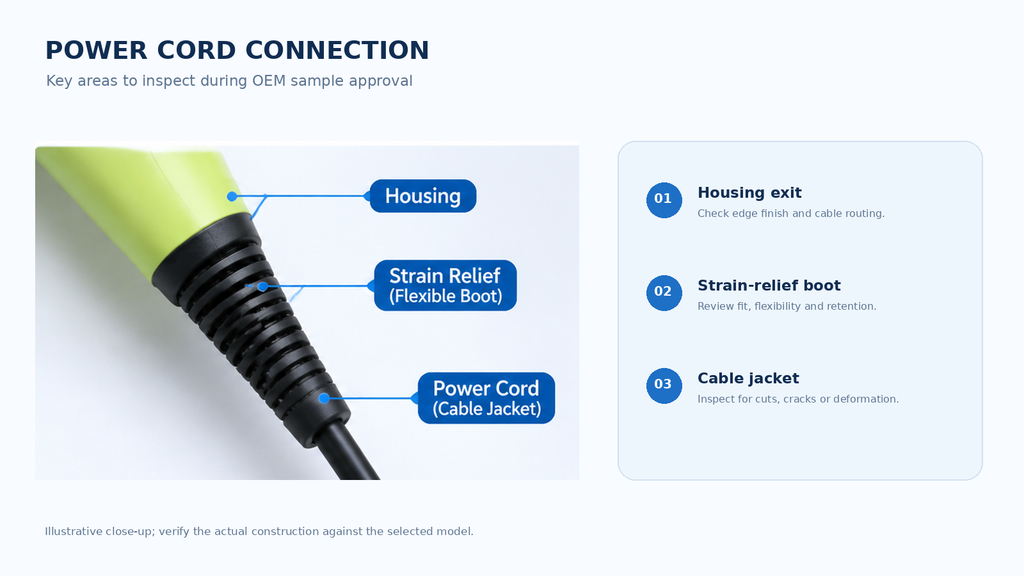
The strain relief is the transition between the appliance body and the flexible cable. Its purpose is to manage mechanical stress where the cord enters or leaves the housing.
During sample review, check:
- Whether the boot is securely retained.
- Whether the cable bends gradually rather than at a sharp edge.
- Whether the housing opening has smooth edges.
- Whether the boot shows cracking, splitting or permanent deformation.
- Whether the cable can be pulled or twisted in a way that transfers stress to internal terminals.
The correct shape and material depend on the appliance design. A strain-relief boot should be evaluated as part of the complete cord assembly, not selected only by appearance.
4. Check Cable Construction and Electrical Ratings
Before mechanical testing, confirm the cord specification. The rated voltage, current, conductor size, insulation system, temperature rating, plug type and destination-market requirements must match the finished appliance.
Ask the manufacturer for the approved cable specification and relevant component documentation. If the product’s rated power or electrical configuration changes, verify whether the cord remains suitable.
Also consider the cable’s outer jacket, flexibility, color, length and compatibility with the intended product finish. A visually attractive cord is not necessarily an electrically appropriate one.
5. Evaluate Cord Flexing and Bending Durability
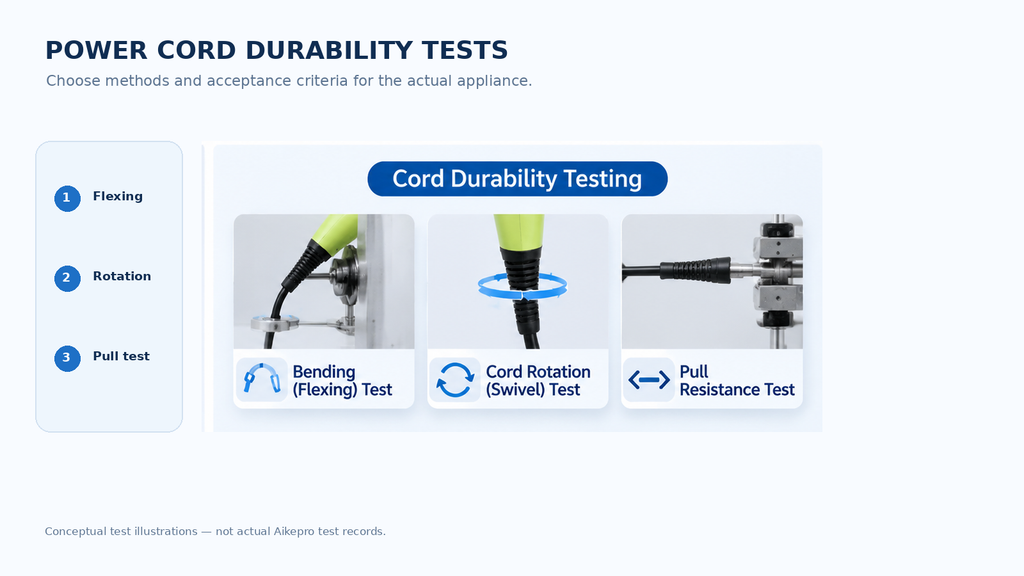
A flexing test is intended to assess how a cord withstands repeated movement under defined conditions. The method may control the bend angle, load, movement rate, number of cycles, fixture geometry and electrical monitoring.
For a hair dryer or straightener, the test location should reflect realistic stress points. The housing exit is often important, but the swivel joint and internal termination may need separate review.
Buyers should request a documented method that identifies:
- The sample model and cord specification.
- The test fixture and bend location.
- The applied load and movement range.
- The cycle count and test duration.
- Whether electrical continuity is monitored.
- The inspection criteria after testing.
Do not copy a cycle count from another product without checking whether the method applies to the current cord and appliance. The manufacturer and qualified test laboratory should define suitable conditions and acceptance limits.
6. Evaluate a 360-Degree Swivel Cord Mechanism
A swivel connection may improve handling by allowing the cord to rotate relative to the appliance. However, the term “360-degree” describes a movement feature, not a guarantee of unlimited rotation or a specific service life.
For sample evaluation, confirm the intended rotation range and whether the joint is designed for continuous rotation, limited rotation or another arrangement.
Observe:
- Smoothness and consistency of rotation.
- Unwanted looseness or binding.
- Noise or rubbing during movement.
- Changes in rotation feel after repeated operation.
- Cable twisting or kinking during ordinary use.
- Any effect on electrical continuity or insulation.
If the swivel contains electrical contacts or a moving conductor arrangement, its electrical and mechanical design should be reviewed together. Do not disassemble a live appliance or improvise electrical tests; use an appropriate engineering or laboratory procedure.
7. Check Pull Resistance and Internal Cord Retention
The cord should remain securely attached during foreseeable handling. Pull-resistance evaluation may help assess the retention of the cable, plug or internal termination, depending on the product and applicable requirements.
The test setup must specify the direction, force, duration and measurement point. The result should be inspected for cable movement, damage to the boot, exposed conductors, terminal displacement or housing damage.
A pull test does not replace flexing, twisting or electrical safety evaluation. Each method addresses a different potential failure mode.
8. Review Electrical Integrity After Mechanical Testing
Mechanical movement can potentially affect conductor connections or insulation. After the agreed mechanical tests, the sample should be checked using appropriate electrical test procedures.
Depending on the product and applicable standards, the evaluation plan may include continuity, insulation resistance, dielectric strength or other required safety checks. The exact tests and limits must be determined by qualified personnel for the finished appliance and target market.
Do not publish a generic pass threshold as if it applies to every hair tool. A report should identify the model, test method, equipment, conditions and result.
9. Consider Heat, Handling and Real-Use Conditions
Hair styling appliances can operate in warm environments and may be handled close to heated components. The cord’s temperature rating and routing should be appropriate for the appliance design.
Review whether the cable can contact hot surfaces during normal use, whether the cord exit is protected from sharp edges and whether the user can store the appliance without tightly wrapping the cord around the body.
If the user manual warns against wrapping the cord around the appliance, that instruction should be clear and consistent with the product design.
For salon-oriented products, consider more frequent handling and longer operating sessions when defining the risk-based validation plan.
10. Build an OEM Power Cord Approval Checklist
| Evaluation Area | What to Check | Evidence to Request |
|---|---|---|
| Cord specification | Electrical rating, conductor and insulation details | Approved cable specification |
| Strain relief | Fit, retention and bend transition | Drawing and sample inspection |
| Flexing | Repeated bending under defined conditions | Test method and report |
| Swivel joint | Rotation feel, wear and conductor integrity | Functional and durability evaluation |
| Pull resistance | Cable and terminal retention | Defined test result |
| Electrical integrity | Applicable continuity and safety checks | Model-specific test records |
| Production control | Approved cord supplier and revision | Golden sample and change-control record |
| User instructions | Handling and storage warnings | Approved manual |
The buyer and manufacturer should decide which checks are routine production inspections and which are sample-based or type tests. Destructive and endurance tests are not necessarily performed on every finished unit.
11. Questions to Ask a Hair Styling Tool Manufacturer
Before approving an OEM order, ask:
- What cord construction and electrical rating are used for the selected model?
- Is the cord fixed or does it use a swivel connection?
- How is the strain relief designed and retained?
- Which cord-flexing, rotation or pull tests are performed?
- Are test methods and acceptance criteria documented?
- Are electrical checks performed after relevant mechanical tests?
- How are cord supplier or material changes controlled?
- Can the manufacturer provide a sample and the relevant model-specific test records?
Clear answers help buyers distinguish a marketing feature from a validated product design.
12. Discuss Cord and Cable Customization With Aikepro
Aikepro manufactures hair styling appliances for overseas beauty brands, wholesalers, importers and distributors. Its published product range includes hair dryers and hair styling brushes with 360-degree swivel cord features, and its website lists cord rotation testing among its quality-control activities.
For an OEM/ODM project, buyers can discuss cord length, plug configuration, product platform, swivel requirements, appearance and sample evaluation. Exact cord specifications, test methods, acceptance criteria, MOQ and compliance documentation should be confirmed for the selected model.
Explore Aikepro’s BLDC Hair Dryer or 3-in-1 Hair Dryer Brush. For a project discussion, contact Aikepro.
よくある質問
What is a strain relief on a hair dryer power cord?
A strain relief is a component or structural feature at the cord entry that helps manage bending and mechanical stress where the cable meets the appliance housing.
Does a 360-degree swivel cord mean the cable cannot twist or fail?
No. A swivel feature is intended to allow rotation, but its durability depends on the joint design, conductor arrangement, assembly and validation. It does not eliminate the need for cord and electrical testing.
What tests should an OEM buyer request for a power cord?
Depending on the design and applicable requirements, relevant evaluations may include flexing, rotation, pull resistance, visual inspection and electrical integrity checks. The method and limits should be selected for the specific product.
Can a power cord be customized for different markets?
Potentially. Cord length, plug type and electrical ratings must be confirmed against the finished product and destination-market requirements. Changing the plug alone does not change the appliance’s voltage rating.
Should every finished unit undergo a cord-flex test?
Not necessarily. Endurance testing is often part of design validation or defined sampling. Routine production checks should follow the product’s quality plan and applicable requirements.
Build a More Reliable Hair Styling Tool With Aikepro
A reliable cord assembly supports everyday handling and helps protect the complete appliance system. For OEM buyers, the best approach is to define cord requirements early, review the actual construction and approve a documented test plan before mass production.
Contact Aikepro with your product category, destination market, cord length, plug requirements and expected order quantity to discuss suitable OEM/ODM options.
Email: info@aikepro.ltd
WhatsApp: +86 198 7694 7310
Website: https://www.aikepro.ltd/