Noise is an important part of the user experience when choosing a hair dryer. While drying speed, airflow and temperature control are often the main selling points, operating sound can also influence how customers perceive product quality.
For beauty brands, wholesalers and distributors, selecting a hair dryer based only on motor speed or power output may overlook an important product characteristic.
A high-performance hair dryer should balance airflow, drying efficiency, temperature stability and acoustic performance.
But how should B2B buyers evaluate hair dryer noise levels? And what should manufacturers consider when developing a quieter hair dryer?
This guide explains the main factors that influence operating noise and provides a practical checklist for evaluating hair dryers before placing a wholesale order.
1. Why Hair Dryer Noise Matters
Hair dryers generate sound through several operating components, including the motor, airflow system and internal mechanical structures.
Excessive or unpleasant operating noise may affect the overall user experience, especially when a product is used frequently.
Noise performance is particularly relevant for:
- Professional salons where appliances operate repeatedly throughout the day.
- Home-use products designed for everyday grooming.
- Premium beauty brands targeting customers who value comfort.
- High-speed hair dryers using brushless motor technology.
- Retailers comparing products within the same price segment.
For B2B buyers, acoustic performance should be considered alongside drying efficiency, product durability and electrical safety.
2. What Determines Hair Dryer Noise Levels?
The operating sound of a hair dryer is influenced by several engineering factors.
Motor Design
The motor is one of the main sources of operating sound.
Different motor structures, rotational speeds and operating conditions can produce different acoustic characteristics.
High-speed brushless motors can support strong airflow in compact product designs. However, a higher motor speed does not automatically mean quieter operation.
The overall motor configuration, mounting structure and airflow system must work together.
Airflow Design
Airflow is another important source of noise.
Air passing through narrow channels, sharp bends or restricted openings may create turbulence and additional sound.
Manufacturers should evaluate:
- Air inlet dimensions.
- Internal airflow channel geometry.
- Air outlet structure.
- Filter resistance.
- Nozzle design.
- Airflow consistency.
A well-designed airflow path can help balance air delivery and acoustic performance.
Internal Structural Vibration
Mechanical vibration can transfer through the motor support, housing and internal components.
If internal parts are poorly secured or the structure has unsuitable resonance characteristics, the resulting sound may become more noticeable.
Motor mounting, component positioning and housing construction should therefore be evaluated during product development.
Accessories and Attachments
Different attachments can change airflow resistance and operating sound.
For example, a concentrator nozzle may produce a different sound profile from a diffuser or other attachment.
Buyers should evaluate the complete product configuration rather than testing only the main unit.
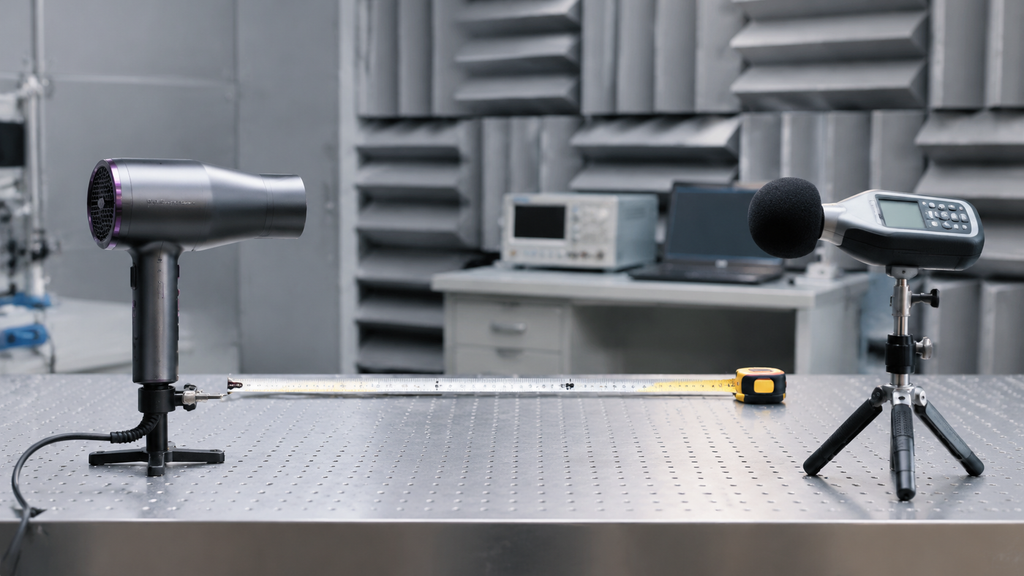
3. Understanding Decibels (dB) in Hair Dryer Testing
Sound levels are commonly expressed in decibels (dB).
However, comparing two hair dryers using only their advertised dB figures may lead to misleading conclusions.
The measurement conditions matter.
Important factors include:
- Distance between the appliance and microphone.
- Measurement position and microphone direction.
- Operating speed and heat settings.
- Whether attachments are installed.
- Background noise in the testing environment.
- Room acoustics and reflective surfaces.
- Measurement equipment and calibration.
For example, a noise reading taken close to the air outlet cannot be directly compared with a reading taken from a greater distance.
B2B buyers should request the testing method and measurement conditions together with the reported result.
A decibel figure without a clearly defined test setup is not enough to establish a fair product comparison.
4. How to Compare Noise Performance Between Hair Dryers
When comparing different models, buyers should use consistent testing conditions.
| Evaluation Item | What Buyers Should Check |
|---|---|
| Operating mode | Test the same speed and heat settings |
| Measurement distance | Use the same microphone distance |
| Measurement position | Keep microphone direction consistent |
| アタッチメント | Test the same nozzle or diffuser configuration |
| Background noise | Use a controlled testing environment |
| Sound stability | Observe changes during continuous operation |
| Operating vibration | Check for unusual housing or motor vibration |
It is also useful to evaluate more than one operating setting.
A hair dryer may have different acoustic characteristics at low, medium and high airflow settings.
The final comparison should consider both measured sound levels and actual listening experience.
5. Why a Lower dB Number Is Not Always the Whole Story
Two products with similar sound-pressure readings may still sound different to users.
This is because perceived sound quality depends on more than overall loudness.
例えば:
- A high-pitched sound may be more noticeable.
- Irregular vibration may create an unpleasant operating experience.
- Changes in airflow may produce inconsistent sound.
- Certain frequencies may become more noticeable in enclosed spaces.
For this reason, product evaluation should combine objective measurement with practical listening tests.
For premium hair styling appliances, sound quality can be an important part of product positioning.
However, claims such as ultra-quiet or silent should only be used when supported by appropriate testing.
6. How Manufacturers Can Improve Hair Dryer Acoustic Performance
Improving acoustic performance requires a systematic engineering approach.
Depending on the product design, manufacturers may consider the following areas.
Optimize the Airflow Channel
The internal airflow path should be designed to minimize unnecessary restrictions and abrupt changes in airflow direction.
Air inlet and outlet structures should be evaluated together with the motor and fan configuration.
Improve Motor Mounting
The motor support structure should provide suitable positioning and mechanical stability.
Reducing unwanted vibration transmission can help improve the overall operating experience.
Review Housing Structure
Housing geometry and internal reinforcement may influence vibration and resonance.
Engineers should evaluate structural behavior during product development rather than relying only on external appearance.
Balance Airflow and Noise
Reducing airflow too much is not a suitable solution if the product is designed for fast drying.
The goal should be to balance airflow performance, drying efficiency, acoustic characteristics and energy consumption.
Test the Complete Product
The final product should be evaluated with its actual attachments, filters and operating configurations.
Engineering improvements should be verified through repeated testing.
7. A Practical Noise Evaluation Checklist for B2B Buyers
Before approving a hair dryer for mass production, buyers can use this checklist.
- Confirm the rated power and motor specifications.
- Request the noise measurement report.
- Confirm the microphone distance and measurement position.
- Check the operating speed and heat settings used during testing.
- Evaluate the product with its standard attachments.
- Listen for unusual high-frequency sounds.
- Check for abnormal motor or housing vibration.
- Compare noise performance under consistent conditions.
- Verify that airflow and drying performance meet the agreed requirements.
- Approve the final production sample before mass production.
This process helps brands make more informed sourcing decisions and reduces the risk of relying on incomplete product specifications.
8. Questions to Ask Your Hair Dryer Manufacturer
When communicating with a potential OEM or ODM supplier, consider asking:
- What motor technology does the hair dryer use?
- Is a noise measurement report available?
- Under what conditions was the noise level measured?
- Can the airflow channel or housing structure be customized?
- How are motor vibration and product stability evaluated?
- Can the manufacturer provide samples for acoustic testing?
- Are the final production specifications consistent with the approved sample?
A capable manufacturing partner should be able to explain its product design, testing conditions and available customization options.
9. Why Choose an Experienced OEM Hair Dryer Manufacturer?
Developing a competitive hair dryer requires more than selecting a motor and heating element.
Product performance depends on the coordination of electrical engineering, airflow design, structural development, material selection and quality control.
At Aikepro, we provide OEM and ODM manufacturing solutions for international beauty brands, wholesalers, importers and distributors.
当社の対応分野は以下のとおりです:
- High-speed and professional hair dryer development.
- Brushless motor product solutions.
- Customized housing and product structures.
- 社内での金型開発および射出成形。
- Product sample development and evaluation.
- Production assembly and quality inspection.
- Customized colors, branding and packaging.
Our standard MOQ starts at 500 pieces, supporting business customers developing or expanding their hair styling appliance ranges.
We work with customers to evaluate product requirements and discuss suitable engineering and manufacturing solutions for different markets.
よくある質問
Q1: What is a good noise level for a hair dryer?
There is no single noise figure that is suitable for every hair dryer. Buyers should compare products using the same measurement distance, operating mode, microphone position and testing environment.
Q2: Are high-speed hair dryers always louder?
No. Motor speed alone does not determine operating noise. Motor design, airflow channels, structural vibration and product configuration all influence acoustic performance.
Q3: Can a hair dryer manufacturer customize noise performance?
Depending on the product platform, manufacturers may review motor mounting, airflow channels, housing structures and other design elements. The feasibility of modifications depends on the existing product architecture.
Q4: Does a concentrator nozzle affect hair dryer noise?
Yes. Different attachments can change airflow resistance and sound characteristics. Buyers should evaluate the actual attachments included in the final product.
Q5: Should B2B buyers request a noise test report?
Yes. A report with clearly documented testing conditions provides a more reliable basis for comparing products and verifying performance claims.
Q6: Can Aikepro develop customized high-speed hair dryers?
Aikepro provides OEM and ODM development and manufacturing solutions for hair dryers and other hair styling appliances. Customization options depend on project requirements, product structure and development scope.
最終的な考察
Hair dryer noise performance is an important consideration when developing products for professional and consumer markets.
For B2B buyers, the best sourcing decision should not be based on a single decibel figure. Motor technology, airflow design, structural vibration, attachment configuration and consistent testing conditions all deserve attention.
Working with an experienced manufacturer can help brands evaluate these factors before mass production.
Looking for an OEM or ODM hair dryer manufacturer?
Contact Aikepro to discuss your product specifications, customization requirements and wholesale projects.
ウェブサイト: https://www.aikepro.ltd/
メール: info@aikepro.ltd
Standard MOQ: 500 pieces.