
A heated brush and a dryer brush can look similar in a product catalog, yet serve different customer routines. Choosing the wrong category can leave a brand promoting drying performance from a product designed only for styling already dry hair.
For buyers comparing heated round brush vs hot air brush options, the first decision is the job the customer needs the appliance to perform. From there, brands can define meaningful specifications, evaluate samples and explain the product clearly at retail.
Heated Round Brush vs Hot Air Brush: Quick Comparison
In this guide, “heated round brush” means an electrically heated round styling brush without forced airflow. A “hot air brush” uses powered airflow through a brush head. Hybrid designs require a closer review.
| Comparison Point | Heated Round Brush Without Airflow | Hot Air Brush / Dryer Brush |
|---|---|---|
| Core mechanism | A heated styling surface helps shape hair while bristles guide the section. | Powered airflow works with the brush head to dry and shape hair. |
| Starting hair condition | Dry hair, according to the selected model’s instructions. | Towel-dried or partially dried hair as instructed; some models also permit dry-hair touch-ups. |
| Main customer routine | Refreshing volume, shaping ends and finishing an existing dry style. | Combining drying and brush styling in a blowout routine. |
| Key specifications | Barrel dimensions, surface temperature control, bristle design and warm-up behavior. | Airflow and heat settings, brush-head design, intake access and any actively heated surfaces. |
| Sample evaluation focus | Control, hair release and shaping performance on dry hair. | Drying and shaping performance with a consistent, permitted starting hair condition. |
| Rotação | May be manual or motorized, depending on the design. | May be manual or motorized; airflow does not itself prove powered brush rotation. |
| Retail positioning | Heated styling brush for dry hair. | Dryer brush with model-specific hair preparation instructions. |
Always follow the operating instructions for the specific model. Product names alone do not establish the permitted starting hair condition or the complete heating mechanism.
1. Understand the Working Principle Before Comparing Features
Heated Round Brushes: Styling After Drying
A conventional heated round brush uses a heated barrel or styling surface to help shape dry hair. The brush structure guides the section while the user lifts, turns or draws the tool through it.
Aikepro’s thermal brush product range includes a model explicitly described as operating without airflow.
For a brand, this points toward dry-hair finishing and style refreshes. Calling such a product a “hair dryer brush” could create the wrong expectation. A blowout-style appearance does not mean the appliance performs a drying function.
Hot Air Brushes: Drying with a Brush-Shaped Tool
A hot air brush combines a powered air stream with a styling head. The permitted starting moisture level depends on the product: instructions may call for thorough towel drying or some preliminary drying. Some models also allow use on dry hair for touch-ups.
Ask the supplier to provide the operating instructions with the sample. Check each model before applying the same hair preparation instructions across an entire product range.
Hybrid Designs: Confirm Both Airflow and Surface Heating
Some dryer brushes combine airflow with an actively heated barrel or heated bristles. These designs show why names such as “hot brush,” “thermal brush” and “dryer brush” are not enough to identify the full mechanism.
For a hybrid product, request a clear description of what is heated, how each mode operates and which hair condition is permitted. A heated barrel alone does not establish that a product has a drying function.
2. Choose the Category Around Your Customer’s Routine
For Dry-Hair Volume and Daily Touch-Ups
A heated round brush is a candidate when the intended customer already dries their hair separately and wants to reshape ends, refresh volume or finish a style.
Your sample review should concentrate on whether the head size, grip and hair-release behavior suit that task. Evaluate how comfortably the user can position the brush, guide a section and release the hair after shaping.
For a Drying-and-Styling Routine
A hot air brush is a candidate when drying is part of the product promise.
Evaluate how the complete tool handles the target routine, including any required pre-drying. Product demonstrations should show the same preparation that appears in the instructions.
For brands, this helps keep the product page, packaging and customer expectations consistent.
For a Range That Includes Both
A brand can offer both categories when each has a clear role. For example, a dryer brush may serve the wash-day routine, while a heated round brush serves later dry-hair styling.
Use distinct product names and demonstrations so buyers understand when to choose each appliance.
If the project involves interchangeable airflow attachments, see our guide to selecting air styler attachments for a separate discussion of accessory combinations.
3. Compare Specifications That Describe the Actual Job
Ask What Each Temperature Figure Measures
A selected temperature setting, a measured barrel surface temperature and an outlet-air temperature describe different things. One number should not be treated as a substitute for the others.
Ask the supplier to state the measurement location, operating mode and test conditions.
For a heated round brush, request surface-temperature measurements and control behavior. For an airflow model, ask about both air-temperature measurements and accessible heated surfaces. For a hybrid, review both systems.
This gives your purchasing team a clearer basis for comparing samples and approving the final specification.
Compare Wattage Within the Correct Product Category
A wattage figure describes electrical power. It does not directly measure the quality of the finished hairstyle.
A contact-heated styling brush and an appliance that heats moving air perform different tasks. Comparing their power ratings alone cannot tell a buyer which is better suited to a particular product line.
Define the required routine first, then evaluate the complete appliance under agreed conditions. Keep the voltage and frequency configuration attached to every quoted power specification.
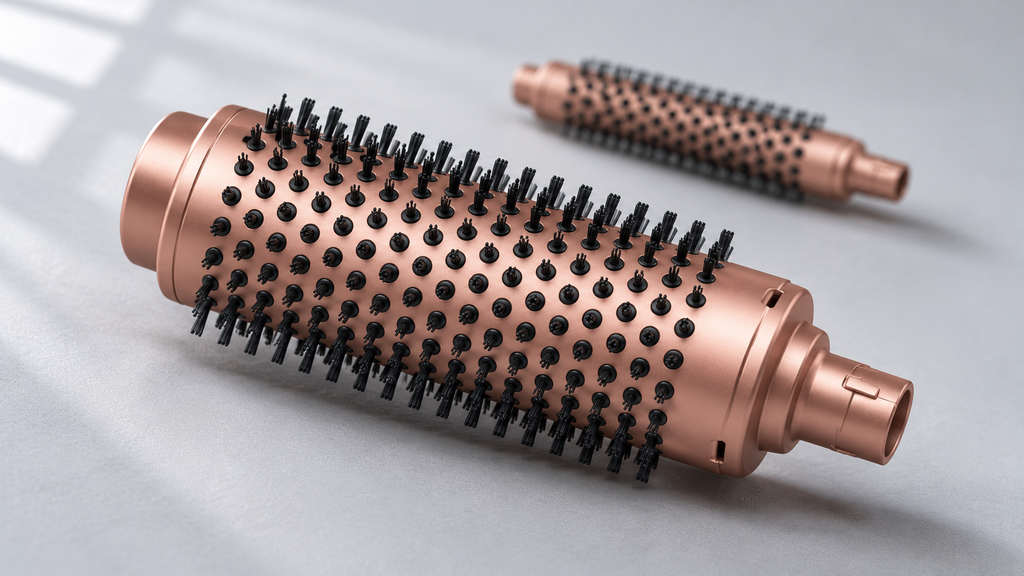
Define Brush Dimensions Precisely
Ask whether the quoted diameter refers to the barrel body or the outside of the bristles.
Also record:
- Usable styling length.
- Brush-head shape.
- Bristle arrangement.
- Bristle length and spacing.
- Removable-head connection, where applicable.
This prevents a comparison based on dimensions that different suppliers have measured differently.
Evaluate the actual sample with the hair lengths and styling tasks your brand intends to address.
Separate Brush Rotation from Airflow and Cord Movement
Ask exactly what rotates and what drives it.
A powered rotating brush head, a hand-turned brush and a swivel power cord are different features. Airflow-assisted hair wrapping is another mechanism that should be specified separately.
If powered rotation is part of the proposal, confirm direction control, speed options and how the user stops it. Include those functions in the approved sample specification.
A functional demonstration should show how the feature operates during the intended styling routine.
4. Evaluate Samples Against a Defined Styling Task
Write a short evaluation brief before comparing samples. State the intended hair condition, target styling result, head configuration and permitted operating settings.
This keeps the review focused on the job promised to the customer.
Heated Round Brush Sample Checks
For a heated round brush, evaluate:
- Shaping performance on dry test sections.
- Ease of turning and positioning the brush.
- Hair release after styling.
- Button placement and control operation.
- Access to the intended handling areas.
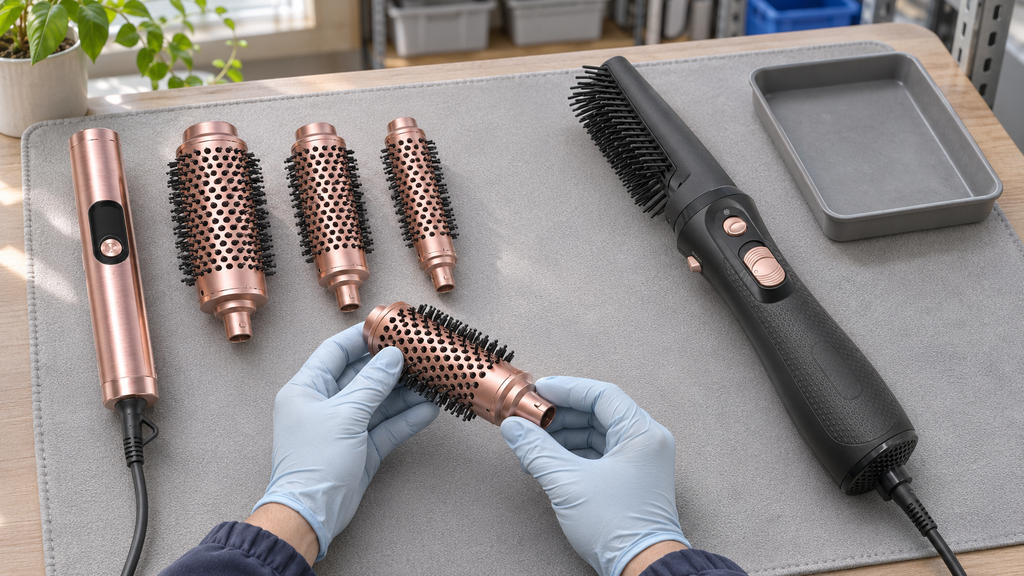
- Attachment fit, where detachable heads are included.
Hot Air Brush Sample Checks
For a hot air brush, evaluate:
- Drying and shaping from a consistent, permitted starting condition.
- Available airflow and heat settings.
- Control operation during styling.
- Handling with the selected brush head.
- Air intake and cleaning access.
- Attachment fit and removal, where applicable.
Keep Comparisons Consistent
Use comparable hair sections and record preparation, technique and operating mode.
If comparing a complete routine, include any required drying step before using the heated round brush. A dry-hair touch-up timed against a damp-hair drying session does not establish which product is universally faster.
Record observations such as snagging, awkward control placement, loose attachments or inconsistent operation. Ask the manufacturer to resolve issues before sample approval.
Electrical protection and compliance evaluation should follow the agreed test plan for the exact product and destination market.
Keep the approved sample and written configuration together. Broader approval steps are covered in our sample evaluation guide.
5. Make Product Names and Instructions Match the Mechanism
Product naming should make the intended routine easy to understand.
“Heated round brush” or “thermal curling brush” can describe a product for dry-hair shaping. “Hot air brush” or “blow dryer brush” can describe a product whose validated function includes drying.
For each model, align the product page, packaging, manual and demonstration video around the same information:
- Whether the appliance dries hair, styles dry hair or supports specified modes for both.
- The required hair preparation and recommended operating sequence.
- What the heat, airflow and rotation controls actually do.
- Which attachments are included.
- How users fit, remove and clean the attachments.
- Any model-specific operating restrictions.
Keep performance claims tied to evidence for the finished model.
A temperature setting, an ionic feature or a ceramic finish should not be presented as a universal promise of faster styling or damage-free results.
Clear product information gives distributors and retail partners a more reliable basis for explaining the appliance to their customers.
6. Plan Your Private Label Brush Project with Aikepro
Aikepro works with overseas beauty brands, wholesalers and distributors on OEM and ODM hair appliances.
Our team brings more than 20 years of industry experience, with in-house mold development and injection molding supporting product customization.
For a heated styling concept, explore the 4-in-1 Detachable Heated Round Brush Set.
For a drying-focused concept, review our hot air brush collection.
Confirm the available configuration and permitted use for the specific model selected.
When requesting a proposal, share:
- Your target country or sales market.
- The customer routine the product should support.
- Preferred brush-head sizes and attachment combinations.
- Electrical requirements.
- Branding and packaging needs.
- Planned order quantity.
- Expected product launch schedule.
These details help our team discuss an appropriate product platform, customization scope and sample arrangement.
MOQ: 500 PCS.
OEM and ODM options are available, with the final configuration and development scope confirmed for each project.
Perguntas frequentes
Is a Heated Round Brush the Same as a Hot Air Brush?
In this comparison, the heated round brush styles with a heated surface and no forced airflow. The hot air brush includes powered airflow and a drying function.
Hybrid products may combine both, so confirm the mechanism and instructions for the selected model.
Can Every Hot Air Brush Be Used on Wet Hair?
No universal preparation rule applies to every model.
Follow the manufacturer’s instructions for towel drying or partial drying, and check whether any modes have different restrictions.
Does PTC Heating Mean the Brush Has No Airflow?
No. PTC describes a heating technology, not the complete appliance.
Ask separately whether the product has a fan-driven air system and whether the barrel or bristles are actively heated.
Does Automatic Rotation Mean Automatic Air Curling?
No. Powered brush rotation and airflow-assisted wrapping are different mechanisms.
Ask for a functional demonstration and a written description of the controls before approving the product specification.
Can a Brand Offer Both Heated Round Brushes and Hot Air Brushes?
Yes. A brand can offer both when the products serve clearly defined routines.
For example, a hot air brush may support drying and styling, while a heated round brush supports later styling on dry hair. Product names, instructions and demonstrations should explain these roles clearly.
What Is Aikepro’s MOQ for Wholesale Projects?
Aikepro’s standard MOQ is 500 PCS.
The product configuration, customization scope, sample requirements and production terms are confirmed during the quotation process.
Discuss the Right Brush Category for Your Brand
Tell us whether your project focuses on dry-hair finishing, drying and styling, or a range covering both routines.
Contacte a Aikepro to discuss samples and an OEM/ODM proposal for your target market.
For Brands, Wholesalers and Distributors
MOQ: 500 PCS | OEM & ODM Available
E-mail: info@aikepro.ltd