
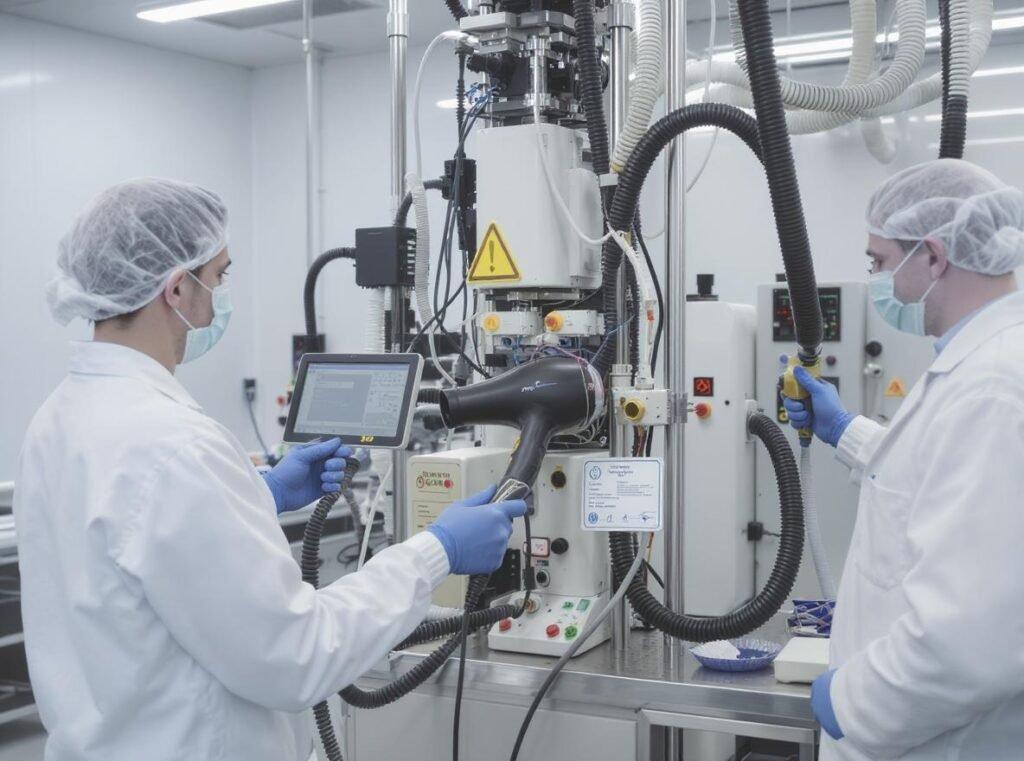
Choosing the right hair styling tools manufacturer is about more than finding competitive prices. For wholesalers, distributors, salon brands and private label businesses, product quality directly affects customer satisfaction, brand reputation and long-term profitability.
A hair dryer, hair straightener, curling iron or air multi-styler may look attractive in product photos, but its actual performance depends on internal components, material quality, electrical safety and manufacturing consistency.
So, how can buyers evaluate a hair styling tools supplier before placing a bulk order?
In this guide, we explain 10 essential quality control points that professional buyers should consider when sourcing hair styling tools from manufacturers.
1. Check the Manufacturer’s Production Experience
The first step is to understand whether the supplier has real manufacturing experience.
An experienced hair styling tools manufacturer should have a clear production process, technical knowledge and the ability to manage different product categories.
When evaluating a factory, consider:
- Years of experience in hair styling tool manufacturing.
- Experience with hair dryers, straighteners and curling irons.
- In-house production capabilities.
- Engineering and product development teams.
- Experience with OEM and ODM projects.
A supplier with established manufacturing experience is generally better positioned to identify potential production problems and maintain consistent product quality.
2. Evaluate Motor Performance and Reliability
For high-speed hair dryers and air styling products, the motor is one of the most important components.
Motor performance influences airflow, drying efficiency, operating noise and product lifespan.
Buyers should check:
- Motor type and rated speed.
- Airflow performance.
- Operating temperature.
- Noise levels.
- Continuous operating stability.
- Motor protection and overheating control.
For high-speed hair dryers, brushless motors are commonly used in premium product designs.
However, a high RPM specification alone does not guarantee better performance. Buyers should also request actual performance test results and evaluate the complete airflow system.
3. Inspect Heating Elements and Temperature Control
Heating performance is another important factor, especially for hair straighteners, curling irons and heated styling brushes.
Unstable temperatures can affect styling results and user experience.
Important inspection points include:
- Heating speed and temperature consistency.
- Temperature adjustment accuracy.
- Overheating protection.
- Heating element durability.
- Temperature distribution across heating surfaces.
For advanced hair styling products, intelligent temperature control can help maintain more consistent heating performance.
Buyers should request temperature test records rather than relying only on the specifications listed in a product catalog.
4. Check Material Quality and Product Construction
The external appearance of a product is important, but material quality is equally important.
Poor-quality plastic, weak connectors or unsuitable coatings can lead to deformation, cracking, paint peeling or premature product failure.
Inspect the following components:
- Housing materials and surface finishing.
- Heating plate materials and coatings.
- Handle and connector construction.
- Switches and buttons.
- Power cord and plug quality.
- Attachments and accessories.
For products with interchangeable attachments, pay special attention to connection strength, fitting accuracy and repeated assembly performance.
A reliable manufacturer should be able to explain the materials used and provide relevant material specifications.
5. Verify Electrical Safety and Certifications
Hair styling tools are electrical appliances, so compliance with the destination market’s requirements is essential.
Different markets may require different certifications, testing and documentation.
For example, buyers should discuss:
- CE requirements for applicable European markets.
- UKCA requirements for applicable UK markets.
- UL or ETL certification for applicable North American markets.
- RoHS requirements where applicable.
- Electrical safety and electromagnetic compatibility testing.
Certification requirements depend on the product design, destination market and applicable regulations.
Always verify the validity and scope of certificates and test reports. Do not assume that one certificate automatically covers every product model or market.
6. Evaluate Product Safety Protection
A professional hair styling product should include appropriate safety protection according to its design and intended use.
Depending on the product category, relevant features may include:
- Overheating protection.
- Overcurrent protection.
- Temperature control systems.
- Automatic shut-off.
- Insulation protection.
- Motor protection.
For heated styling tools, temperature stability and thermal protection deserve particular attention.
For high-speed hair dryers, buyers should also evaluate airflow design, motor protection and the reliability of internal electrical connections.
7. Review the Factory’s Quality Control Process
Quality control should not happen only at the end of production.
A well-organized factory should have inspection procedures covering incoming materials, production processes and finished products.
A typical quality control system includes:
Incoming Quality Control (IQC)
- Check incoming components and raw materials.
- Verify specifications and supplier quality.
- Identify defective materials before production.
In-Process Quality Control (IPQC)
- Monitor assembly procedures.
- Check component installation.
- Inspect product appearance and functionality.
- Identify production defects early.
Final Quality Control (FQC)
- Test product functions.
- Inspect appearance and accessories.
- Verify packaging and product labeling.
- Check electrical and safety-related requirements according to the approved inspection plan.
Pre-Shipment Inspection
- Verify order quantities.
- Check packaging and carton conditions.
- Perform sampling or agreed inspection procedures.
- Confirm that products meet the approved specifications.
For bulk orders, buyers should request a clear inspection standard before production begins.
8. Test Product Durability Before Bulk Production
A product may work perfectly during a short demonstration but develop problems after repeated use.
This is why durability testing matters.
Depending on the product category, buyers can request:
- Continuous operation testing.
- Switch and button life testing.
- Power cord bending testing.
- Drop testing.
- Attachment connection testing.
- Heating cycle testing.
- Temperature stability testing.
- Packaging transportation testing.
Not every test applies to every product. The inspection plan should be based on the product’s construction, intended use and applicable standards.
It is also important to keep an approved reference sample before mass production.
This sample can serve as a benchmark for appearance, performance, materials and assembly quality.
9. Check Packaging and Shipping Protection
Even a high-quality product can arrive damaged if its packaging is inadequate.
Before shipment, buyers should check:
- Inner packaging protection.
- Product positioning inside the box.
- Protection for fragile attachments.
- Carton strength.
- Shipping marks and labels.
- Product manuals and accessories.
- Packaging compliance with destination market requirements.
For international B2B shipments, packaging should be designed to reduce damage during handling, transportation and storage.
Battery-powered products may also require additional transport documentation and shipping arrangements.
10. Understand the Warranty and After-Sales Policy
A reliable supplier should provide clear after-sales terms before the purchase order is confirmed.
Buyers should discuss:
- Standard warranty period.
- How defective products are reported.
- Required evidence for quality claims.
- Replacement arrangements.
- Spare parts availability.
- Responsibility for confirmed manufacturing defects.
The warranty agreement should clearly define the covered defects, exclusions and claim procedures.
Avoid relying on vague promises such as unlimited responsibility or lifetime replacement without written terms.
A clear agreement protects both the buyer and the manufacturer.
Why Choosing the Right Hair Styling Tools Manufacturer Matters
For a growing beauty brand, selecting a manufacturer is not simply a purchasing decision. It is a long-term business decision.
The right manufacturing partner can help buyers:
- Develop differentiated products.
- Maintain consistent quality.
- Customize product appearance and packaging.
- Reduce production risks.
- Improve time to market.
- Build a stronger brand identity.
At Aikepro, we focus on professional hair styling tools manufacturing and OEM/ODM cooperation.
Our manufacturing advantages include:
- MOQ starting from 500 pieces.
- Over 20 years of industry expertise.
- In-house mold development and injection workshop.
- Free mold development for eligible customization projects.
- Full inspection procedures.
- Global certification support.
- Clear quality responsibility and after-sales arrangements.
- Free replacement for confirmed covered quality issues under agreed warranty terms.
We work with international brand owners, wholesalers, distributors and importers to develop hair dryers, hair straighteners, curling irons, air multi-stylers and other professional hair styling products.
Final Checklist Before Placing a Bulk Order
Before confirming your next purchase order, make sure you have evaluated these 10 points:
- Manufacturer’s production experience.
- Motor performance and reliability.
- Heating performance and temperature control.
- Material quality and product construction.
- Electrical safety and certifications.
- Product safety protection.
- Factory quality control procedures.
- Durability test results.
- Packaging and shipping protection.
- Warranty and after-sales terms.
A lower purchase price does not always mean a lower total cost. Consistent quality, reliable production and professional technical support are essential when building a successful hair styling tools brand.
Looking for a Reliable Hair Styling Tools Manufacturer?
If you are sourcing hair dryers, hair straighteners, curling irons or customized air multi-stylers, Aikepro can support your OEM and ODM projects.
Contact our team to discuss your product requirements, customization options and bulk order plans.
Website: https://www.aikepro.ltd/
Let’s develop your next hair styling product together.