When developing or sourcing a hair dryer, one of the most important decisions is choosing the right motor.
The motor directly influences airflow performance, product weight, noise characteristics, energy consumption and overall product positioning.
For hair dryer brands, wholesalers and professional salon equipment distributors, understanding the differences between AC, DC and BLDC motors can help you select the right product for your target market.
But which motor is actually better?
In this guide, we compare three common motor technologies and explain what B2B buyers should consider before placing an OEM or ODM order.
1. What Are the Three Types of Hair Dryer Motors?
Hair dryers commonly use different motor technologies depending on their intended application, performance requirements and price positioning.
AC Motor – Traditional Professional Hair Dryer Motor
AC motors have been widely used in traditional professional and salon hair dryers.
They are commonly selected for products that require established motor technology and strong drying performance.
Key characteristics:
- Established technology with extensive industry experience.
- Commonly used in traditional professional hair dryers.
- Suitable for products designed around conventional salon applications.
- Motor size and weight depend on the specific design.
- Performance and operating noise vary by motor construction.
AC motor hair dryers remain a practical option for brands targeting conventional salon and professional hair dryer markets.
DC Motor – Lightweight and Cost-Effective Solution
DC motors are commonly found in household and entry-level to mid-range hair dryers.
They can provide a compact and relatively lightweight solution for products where affordability and ease of use are important.
Key characteristics:
- Suitable for compact product designs.
- Can help reduce overall product weight.
- Commonly used in household hair dryers.
- Offers flexibility for different product price points.
- Performance depends on motor design and electrical configuration.
For brands targeting everyday consumers and value-oriented retail channels, DC motor hair dryers can be a suitable choice.
BLDC Motor – High-Speed Brushless Technology
BLDC stands for Brushless DC Motor.
Unlike conventional brushed DC motors, BLDC motors use electronic commutation rather than mechanical brushes.
This technology has become increasingly popular in modern high-speed hair dryers.
Key characteristics:
- Brushless motor construction.
- Supports high-speed motor designs.
- Can deliver strong airflow performance when paired with an optimized air duct and fan system.
- Can support compact and lightweight product designs.
- Offers opportunities for advanced electronic control.
- Requires appropriate electronic control and thermal management.
For premium hair care brands and professional styling appliance distributors, BLDC technology offers opportunities to develop differentiated high-speed hair dryers.
2. AC vs DC vs BLDC Hair Dryer Motor Comparison
Here is a practical comparison for B2B buyers.
| Comparison | AC Motor | Двигатель постоянного тока | Двигатель BLDC |
|---|---|---|---|
| Технологии | AC motor | Brushed DC (common type) | Brushless DC |
| Typical Application | Traditional salon dryers | Household dryers | High-speed dryers |
| Скорость двигателя | Design dependent | Design dependent | Can support high RPM |
| Вес изделия | Design dependent | Often compact | Can support compact designs |
| Noise | Design dependent | Design dependent | Design dependent |
| Electronic Control | Varies | Varies | Requires electronic commutation |
| Cost Positioning | Varies | Often economical | Generally higher system complexity |
| Market Positioning | Traditional professional | Everyday consumer | Premium and high-speed |
Important: These are general design tendencies, not guaranteed performance results. Actual airflow, noise, durability, temperature and weight depend on the complete hair dryer design rather than motor type alone.
3. Why Are BLDC Motors Popular in High-Speed Hair Dryers?
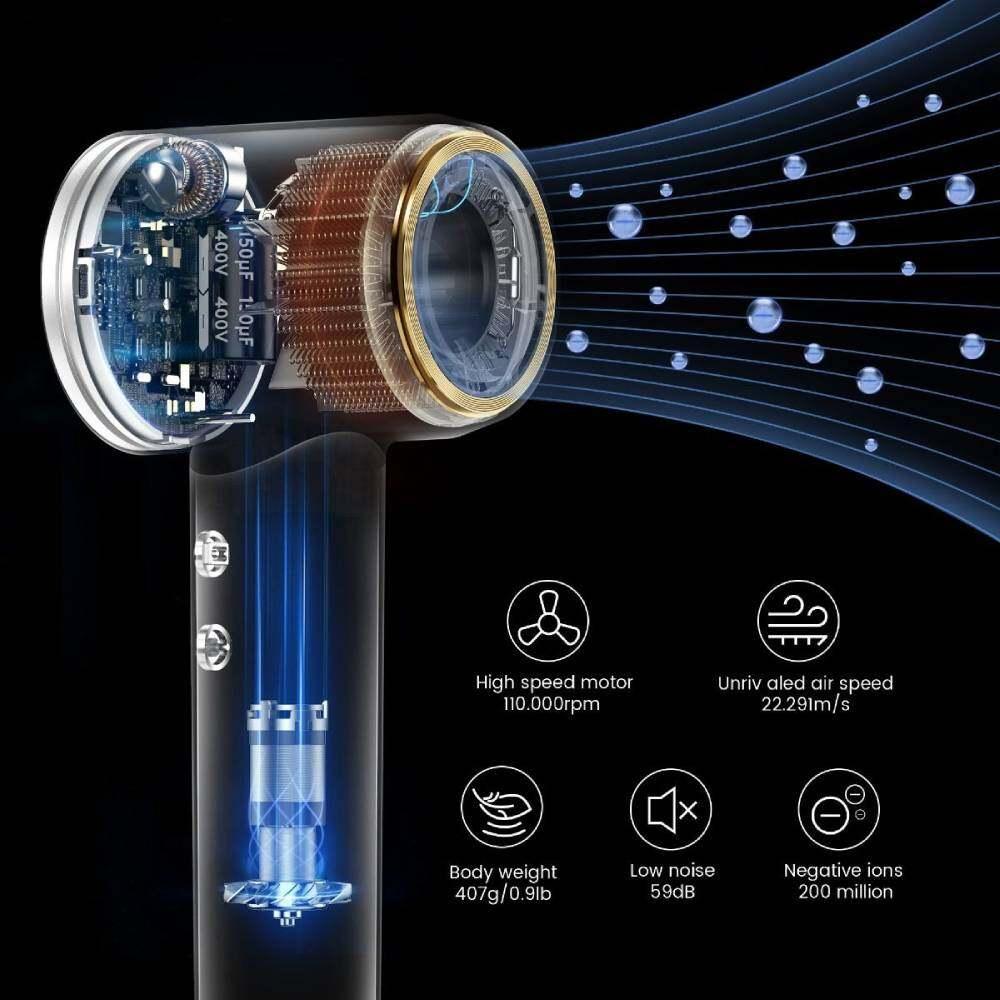
The growing interest in high-speed hair dryers has made BLDC motor technology an important development direction.
However, high RPM alone does not guarantee better drying performance.
There are several factors brands should evaluate.
1. High Motor Speed
A high-speed motor can support a compact fan system operating at high rotational speeds.
Some modern hair dryers use motors with speeds exceeding 100,000 RPM.
For example, Aikepro offers high-speed hair dryer models featuring 110,000 RPM brushless motors.
2. Airflow Performance
Motor speed is only one part of the airflow system.
The impeller, air duct, air outlet and internal structure all influence the final airflow performance.
When comparing suppliers, buyers should request actual airflow measurements rather than relying only on RPM specifications.
3. Product Weight and Ergonomics
A well-designed high-speed hair dryer can offer a more compact product structure.
This can be particularly useful for premium consumer products and professional salon applications where handling comfort matters.
4. Intelligent Temperature Control
BLDC motor technology can be integrated with electronic control systems.
Depending on the product design, manufacturers can develop functions such as:
- Несколько настроек температуры.
- Intelligent temperature monitoring.
- Airflow adjustment.
- LCD temperature displays.
- Automatic operating modes.
These functions provide opportunities for brands to create differentiated product offerings.
5. Noise and Vibration Optimization
A high-speed motor requires careful engineering.
Fan balancing, airflow channel design, housing structure and vibration control all influence the final noise level.
A high RPM specification should never be treated as proof that a product is quiet.
4. Which Hair Dryer Motor Should Your Brand Choose?
The right motor depends on your target customers, product price and positioning.
For Entry-Level and Everyday Hair Dryers
A DC motor can be a practical option when your priorities include cost control, conventional performance and accessible retail pricing.
For Traditional Professional Salon Hair Dryers
An AC motor may be appropriate when developing products based on established salon dryer designs and application requirements.
For Premium High-Speed Hair Dryers
A BLDC motor is worth considering when your brand wants to develop modern high-speed products with advanced airflow and electronic control features.
Our recommendation is to evaluate the complete product configuration instead of selecting a motor based on its name alone.
5. What Should B2B Buyers Check Before Choosing a Hair Dryer Motor?
Before placing a bulk order, we recommend checking the following technical details with your manufacturer.
Motor Specifications
Ask for:
- Motor type.
- Rated voltage.
- Rated power.
- Motor speed (RPM).
- Motor dimensions.
- Expected operating conditions.
Airflow Performance
Check:
- Air velocity.
- Air volume.
- Air pressure.
- Air outlet design.
- Performance under different operating modes.
Noise and Vibration
Request actual noise test results and check the product under different speed settings.
Регулирование температуры
Confirm how the heating element, temperature sensor and control board work together.
Durability and Safety
Evaluate:
- Continuous operation testing.
- Motor temperature.
- Electrical safety.
- Insulation performance.
- Overheating protection.
- Product aging tests.
Product Certification
Confirm the applicable electrical safety and compliance requirements for your destination market before mass production.
6. Why Motor Selection Should Be Part of OEM/ODM Product Development
For private label brands, selecting a motor is not just a technical decision.
It affects the entire product development process.
A successful OEM/ODM project should consider:
Product Positioning
Define whether the target product is an entry-level household dryer, professional salon dryer or premium high-speed hair dryer.
Industrial Design
The motor dimensions influence the internal product layout, handle size, air inlet and overall appearance.
Electrical Engineering
The PCB, power supply, heating element and temperature control system must work together with the selected motor.
Airflow Engineering
The impeller and air duct should be optimized for the motor’s operating characteristics.
Prototype Testing
Build functional prototypes and evaluate airflow, temperature, noise, weight and safety before approving the final design.
Серийное производство
After confirming the design and testing results, the manufacturer can proceed with production planning and quality inspection.
Choosing the motor at the beginning of development can help avoid unnecessary redesign and additional costs.
7. How Aikepro Supports High-Speed Hair Dryer Manufacturing
Aikepro is a professional hair styling appliance manufacturer specializing in hair dryers, hair straighteners, curling irons, air stylers and hair clippers.
We support international brands, distributors, wholesalers and private label businesses with OEM and ODM manufacturing solutions.
Our capabilities include:
- More than 20 years of hair tools industry experience.
- In-house mold development and injection molding.
- Product appearance and structural development.
- Electronic and functional customization.
- High-speed hair dryer solutions with brushless motors.
- Quality inspection and product testing.
- Custom colors, logos and packaging.
- Support for applicable international certification requirements.
Our high-speed hair dryer product range includes models equipped with 110,000 RPM brushless motors.
Explore our High-Speed Brushless Hair Dryer to learn more about our product solutions.
Whether you are developing a new premium hair dryer or expanding an existing private label product line, we can discuss the appropriate motor configuration based on your requirements.
8. Frequently Asked Questions
Q1: Is a BLDC motor better than a DC motor in a hair dryer?
Not in every situation. BLDC motors offer brushless construction and can support high-speed designs. However, the best choice depends on product positioning, performance requirements, cost and overall engineering.
Q2: Why do high-speed hair dryers use BLDC motors?
BLDC motors can support high rotational speeds and compact motor designs. They are therefore commonly used in modern high-speed hair dryers.
Q3: Does a higher RPM always mean stronger airflow?
No. Airflow also depends on the impeller, air duct, inlet design and outlet structure. Buyers should compare measured airflow and air pressure, not RPM alone.
Q4: Are BLDC hair dryers quieter?
Not automatically. Noise depends on motor design, fan balancing, airflow structure, vibration and housing materials. Actual sound measurements are needed.
Q5: Can a manufacturer customize the motor configuration?
Depending on the project, manufacturers may be able to customize motor selection, electrical configuration, airflow structure, control functions and product appearance. Feasibility should be evaluated during product development.
Q6: What information should I provide when requesting a hair dryer OEM quotation?
It is helpful to provide your target market, preferred motor type, rated voltage, desired power, product positioning, estimated order quantity and customization requirements.
Conclusion: Choose the Right Motor for the Right Market
AC, DC and BLDC motors each have their own applications in the hair dryer industry.
AC motors remain relevant for traditional professional products, DC motors offer practical options for everyday consumer dryers, and BLDC motors provide opportunities for modern high-speed product development.
For brands and distributors, the best motor is the one that matches the target market, product performance requirements and commercial positioning.
Looking for a high-speed hair dryer manufacturer for your next project?
Contact Aikepro to discuss OEM/ODM development, brushless motor hair dryers, private label customization and wholesale cooperation.
Website: https://www.aikepro.ltd/
Email: info@aikepro.ltd
Let’s develop your next hair styling product together.