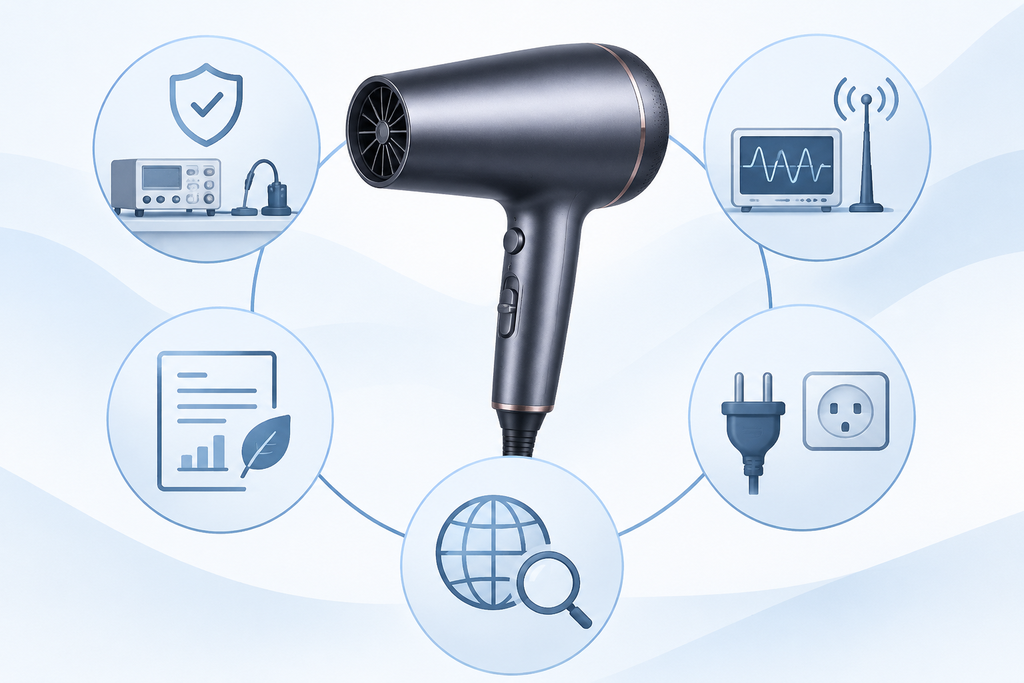
When sourcing hair dryers from overseas manufacturers, product design, performance and pricing are important. However, one factor that should never be overlooked is product certification and regulatory compliance.
For international distributors, wholesalers, salon brands and private label businesses, understanding hair dryer certifications before placing a bulk order can help reduce customs delays, compliance risks and unexpected costs.
Different countries have different electrical safety, electromagnetic compatibility and environmental requirements. A certificate accepted in one market does not automatically mean the same product can be sold in another.
In this guide, we explain the major compliance requirements that buyers should understand when sourcing hair dryers from manufacturers.
1. Why Are Hair Dryer Certifications Important?
Hair dryers are electrical appliances that operate with heating elements, motors and electrical circuits. Their design must meet the applicable safety and performance requirements of the destination market.
Proper compliance helps buyers:
- Reduce the risk of electrical safety problems.
- Meet applicable import and market access requirements.
- Improve customer and distributor confidence.
- Prepare product documentation for customs and market surveillance.
- Build a more reliable private label brand.
For B2B buyers, certification should be discussed during the product development stage rather than after mass production.
2. Major Hair Dryer Certifications by Market
Different markets follow different regulatory systems. Below are some important examples for international buyers.
European Union – CE and RoHS
For applicable hair dryers sold in the European Union, CE marking indicates that the manufacturer has declared conformity with the relevant EU legislation.
Depending on the product design, applicable requirements may include:
- Low Voltage Directive (LVD).
- Electromagnetic Compatibility Directive (EMC).
- RoHS restrictions on hazardous substances.
- Applicable product safety and environmental requirements.
Buyers should request the relevant EU Declaration of Conformity and supporting technical documentation.
CE marking is not simply a quality certificate issued by a testing laboratory. The manufacturer or responsible economic operator must ensure that the applicable conformity assessment procedure has been completed.
United States – UL, ETL and FCC
For the US market, electrical safety and electromagnetic compatibility are important considerations.
Commonly discussed requirements include:
- UL standards and certification for applicable electrical appliances.
- ETL certification through an OSHA-recognized testing laboratory.
- FCC compliance where applicable to electromagnetic emissions.
UL and ETL are different certification routes. Buyers should verify that the testing laboratory is appropriately recognized and that the certification covers the exact product model.
Not every hair dryer automatically requires the same FCC authorization. The applicable requirements depend on its electronic design and functions.
Canada – cUL, cETL and CSA
Canada has its own electrical product safety requirements.
Common certification marks include:
- cUL.
- cETL.
- CSA.
The certification should be issued under an applicable Canadian approval scheme by an appropriately accredited or recognized organization.
Buyers should confirm that the product model, electrical ratings and intended market are covered by the certification.
United Kingdom – UKCA and Applicable UK Requirements
For hair dryers supplied to the UK market, buyers should review the applicable UK electrical safety, EMC and environmental legislation.
UKCA and CE marking recognition depends on the product category and current UK market rules.
Before production, confirm which marking and conformity documentation are accepted for the specific product and sales destination.
Australia and New Zealand – RCM
The Regulatory Compliance Mark (RCM) is used for applicable electrical and electronic products in Australia and New Zealand.
Depending on the product, requirements may include electrical safety and electromagnetic compatibility obligations under the applicable regulatory framework.
Buyers should confirm the supplier’s ability to support the required testing, registration and compliance documentation.
Russia and Eurasian Economic Union – EAC
For products entering markets covered by applicable Eurasian Economic Union technical regulations, EAC conformity assessment may be required.
The exact requirements depend on product classification, technical regulations and the applicable conformity assessment procedure.
Importers should verify whether a declaration or certificate is needed and whether the product model is covered.
Middle East – GCC Requirements
For applicable electrical products entering GCC markets, the GCC conformity system and relevant national requirements may apply.
Buyers should confirm whether the specific hair dryer falls within the regulated product scope and which documents are required for the destination country.
3. What Documents Should Buyers Request from a Hair Dryer Manufacturer?
Before placing a bulk order, professional buyers should request more than a simple certificate image.
A reliable manufacturer should be able to provide relevant documentation according to the product and target market.
Important documents may include:
1. Product Test Reports
Test reports help demonstrate that the product has been evaluated against applicable technical requirements.
2. Certificates or Conformity Documents
Request the relevant certification or declaration, depending on the regulatory system.
3. Product Specifications
Check rated voltage, frequency, wattage, plug type, motor specifications and other electrical parameters.
4. Product Label and Rating Plate
Confirm that the product label contains the required electrical ratings, manufacturer information and applicable compliance markings.
5. User Manual
The instruction manual should include appropriate safety warnings, operating instructions and maintenance information.
6. Model and Certificate Consistency
Check that the model number, factory details and product configuration match the documents provided.
A certificate for a similar product does not necessarily cover your customized model.
4. Does Changing the Product Design Affect Certification?
Yes. This is an important issue for OEM and ODM projects.
Many brands customize hair dryers with different colors, logos, packaging, plugs and electrical configurations.
However, some changes may affect the original compliance assessment.
على سبيل المثال:
- Changing the motor or heating element.
- Modifying internal electrical components.
- Changing the rated voltage or power.
- Modifying the PCB or temperature control system.
- Adding wireless or electronic functions.
- Changing the product structure or safety-related materials.
Even when the external appearance remains unchanged, internal modifications may require additional testing or a review of existing certification coverage.
Before approving a customized product, buyers should ask the manufacturer and the relevant testing organization whether the changes affect the existing compliance documentation.
5. What Should You Check Before Placing a Bulk Order?
To avoid unexpected compliance costs, we recommend following this checklist.
| Checkpoint | What Buyers Should Confirm |
|---|---|
| السوق المستهدفة | Confirm the exact destination country |
| Product Model | Confirm the final model and configuration |
| الجهد المقنن | Verify voltage and frequency |
| نوع القابس | Confirm the correct local plug |
| الشهادة | Identify applicable compliance requirements |
| تقارير الاختبار | Request relevant supporting documents |
| Product Label | Check ratings and required markings |
| User Manual | Confirm language and safety information |
| التخصيص | Review whether changes affect compliance |
| Production | Approve the compliant reference sample |
It is also advisable to agree on who will be responsible for testing fees, certification applications and any additional compliance costs before production starts.
6. How Aikepro Supports Global Hair Dryer Projects
At Aikepro, we understand that international brands need more than a competitive product price. They need a manufacturing partner that can support product development, customization, quality control and export requirements.
Aikepro specializes in professional hair dryers and other hair styling tools for international wholesalers, distributors and private label brands.
Our manufacturing capabilities include:
- Over 20 years of hair tools industry expertise.
- In-house mold development and injection molding.
- OEM and ODM product customization.
- Flexible product design, color and packaging options.
- Quality inspection throughout the production process.
- Support for relevant global certification requirements.
- One-year standard product warranty under agreed terms.
Our product range includes high-speed hair dryers, professional salon hair dryers, ionic hair dryers, infrared hair dryers and customized hair styling products.
We work with buyers to understand their target market and product requirements before moving forward with mass production.
7. Frequently Asked Questions About Hair Dryer Certifications
Q1: Is CE certification enough to sell a hair dryer worldwide?
No. CE marking applies to relevant European legislation. Other markets have their own regulatory requirements, such as applicable UL or ETL routes in the United States, Canadian approval requirements and EAC requirements in relevant Eurasian markets.
Q2: Can one hair dryer model have multiple certifications?
Yes. A product can be evaluated and certified for multiple markets, provided it meets each applicable requirement and the relevant certification scope covers the product configuration.
Q3: Can I use my supplier’s existing certificate for my private label hair dryer?
Not automatically. You should check the certificate holder, model number, factory information, product configuration and applicable conditions. Changes in branding or manufacturing arrangements may also need to be reviewed.
Q4: Should certification be completed before mass production?
It is best to identify applicable requirements early and complete the necessary evaluation before the product is placed on the market. Pre-production testing and design reviews can help avoid costly modifications later.
Q5: Does changing the plug affect certification?
It may. A different plug, voltage or electrical configuration can affect product compliance and documentation. Always confirm with the relevant certification body or testing laboratory.
Conclusion: Choose a Manufacturer That Understands Global Compliance
Choosing a hair dryer manufacturer is not just about comparing prices and product specifications.
For international brands and distributors, compliance documentation, electrical safety, manufacturing consistency and after-sales support are all important factors.
Before placing your next bulk order, make sure you understand the certification requirements of your target market and verify that the final product model is properly covered.
Looking for a reliable hair dryer manufacturer for your OEM or ODM project?
Aikepro supports international brands, wholesalers and distributors with professional hair dryer manufacturing, product customization and quality control.
Contact us to discuss your next hair dryer project, request product samples or explore private label solutions.
Website: https://www.aikepro.ltd/
Email: info@aikepro.ltd
Let’s build your next hair styling product together.