
A hair dryer’s air inlet is easy to overlook when buyers compare motor speed, wattage, temperature settings and appearance. Yet the inlet is where ambient air enters the appliance. Dust, lint and loose fibers can collect around the intake area, and a poorly considered inlet design can make routine cleaning difficult or affect airflow as the product is used.
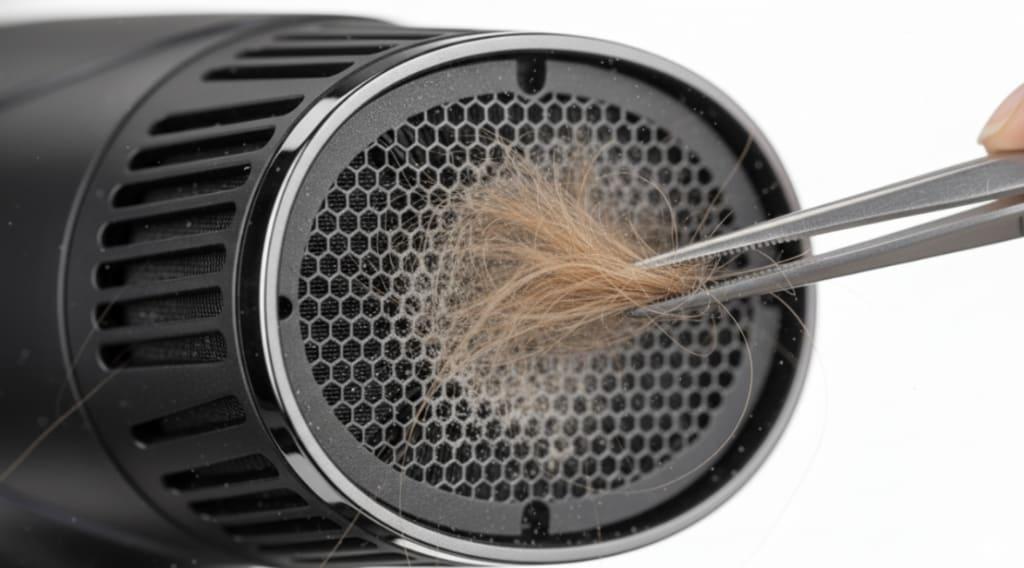
For beauty brands, importers and distributors developing a private label hair dryer, the air inlet filter deserves attention during product specification and sample approval. This guide explains the design questions to discuss with an OEM manufacturer, the checks that can be included in a product evaluation plan, and the information that should appear in user instructions.
The exact filter construction varies by model. This article describes general engineering considerations rather than claiming that every hair dryer uses a removable mesh filter or the same cleaning method.
1. Why the Air Inlet Design Matters
The inlet assembly usually includes an external grille or cover and, depending on the design, a screen, mesh or other protective structure. Its purpose is to help manage what can enter the airflow path while allowing the appliance to draw in air.
For an OEM buyer, the design needs to balance airflow, protection from larger foreign particles, secure attachment, cleanability where applicable, safe edges and compatibility with the motor, fan, housing and thermal protection system.
A finer screen is not automatically better. A more restrictive structure may affect inlet resistance, while a very open structure may provide less protection. The right design must be evaluated as part of the complete appliance.
2. Understand the Difference Between a Grille, Screen and Filter
Product descriptions sometimes use the words grille, mesh and filter as if they mean the same thing. In engineering discussions, clarify what each component actually does.
| Component | Typical Role | Questions for the Manufacturer |
|---|---|---|
| Inlet grille or cover | Outer protective structure and access barrier | How is it attached? Can it be removed? Are the edges smooth? |
| Mesh or screen | Finer barrier within the inlet assembly, depending on design | What is the material? How is it retained? Can it be cleaned? |
| Internal filter element | Additional particle management in selected designs | Is it replaceable? What maintenance is required? |
Do not assume that a product has a replaceable filter simply because its marketing materials mention an air filter or dust protection. Ask for a component drawing or a sample demonstration.
3. Evaluate Mesh Material and Construction
Depending on the appliance design, the inlet screen may use metal mesh, a molded grille, a perforated component or a combination. Each construction has different implications for durability, airflow and cleaning.
During sample review, confirm:
- The material and surface finish.
- Whether the screen is fixed, removable or integrated into the cover.
- How the mesh or grille is retained during normal operation.
- Whether the structure can deform under expected handling.
- Whether cleaning tools or methods could damage the component.
- Whether the design creates areas where lint is difficult to remove.
For a customized housing or new mold, consider the inlet structure early. Changing the opening pattern or screen arrangement may affect appearance, structural strength, tooling and airflow behavior.
4. Check Whether the Inlet Is Easy to Clean
Maintenance is part of the product experience. If dust accumulates around an inlet, users need clear instructions on how to inspect and clean it safely.
For a user-removable cover, evaluate whether the opening and closing action is understandable, whether the part can be reinstalled correctly and whether it remains secure after repeated removal.
If the filter is not designed for user removal, the manual should not instruct customers to dismantle the appliance.
Ask the manufacturer to provide the approved cleaning procedure for the exact model. It should state whether the appliance must be switched off, unplugged and allowed to cool, which tools are permitted, and whether water or cleaning agents are prohibited.
Never recommend inserting sharp objects into the inlet or opening the appliance housing unless the manufacturer has specifically designed and documented that service procedure.
5. Understand How Inlet Restriction Can Affect Performance
As lint and dust accumulate, the effective open area of an inlet can change. Depending on the product design, this may influence airflow, operating conditions, noise or thermal behavior.
OEM sample evaluation can consider the inlet assembly in its clean condition and under a defined, controlled loading condition. Any simulated dust or lint test should use an agreed method and should not be presented as a universal industry standard unless the applicable standard or protocol is identified.
Useful observations may include:
- Airflow or air-velocity readings using the same setup before and after evaluation.
- Changes in sound or vibration.
- Operating temperature and the response of protective functions.
- Whether debris can be removed using the documented cleaning method.
- Whether the inlet cover or screen remains securely fitted.
Test conditions, loading material, duration, instrument position and acceptance limits should be documented.
A single demonstration with a visibly dirty filter is not sufficient evidence of long-term reliability.
6. Include the Inlet Assembly in Safety and Reliability Reviews
The inlet is connected to the appliance’s internal airflow path. Its evaluation should be coordinated with the motor, fan, heater, wiring, housing and protective systems.
For the selected model, the engineering and compliance teams should review foreseeable misuse, access to internal moving parts, material suitability, abnormal operation and any effect that an inlet change may have on the finished product assessment.
If an OEM project changes the grille geometry, mesh material, housing openings or internal airflow path, ask whether the modification requires additional engineering validation or a review of existing compliance documentation.
A cosmetic change and a safety-relevant structural change should not be treated as equivalent.
7. Compare Manual Cleaning and Automatic Cleaning Features
Some hair dryers use a user-cleaned inlet structure. Other models may include a designed cleaning function, such as a reverse-airflow or automatic cleaning mode. The available feature and correct operating procedure are model-specific.
Aikepro’s published professional high-speed hair dryer page describes an automatic cleaning function intended to help maintain the airflow system.
An automatic cleaning feature should not be described as eliminating all maintenance unless that claim has been validated. Users may still need to inspect external openings and follow the product manual.
For private label projects, ask the manufacturer to provide a clear explanation of how the feature operates and which cleaning steps remain necessary.
8. Build an OEM Air Inlet Evaluation Checklist
| Evaluation Area | What to Check | Evidence to Request |
|---|---|---|
| Construction | Grille, mesh, filter and attachment method | Component drawing or approved sample |
| Material | Material identification, finish and deformation resistance | Material specification |
| Fit and Retention | Secure fit and repeated removal where applicable | Functional evaluation record |
| Cleanability | Access, approved tools and reinstallation | Cleaning instruction and demonstration |
| Airflow | Performance under defined clean and controlled loading conditions | Test method and comparative results |
| Noise and Temperature | Changes during the agreed evaluation | Documented operating test |
| Safety | Access protection and interaction with internal components | Model-specific engineering and compliance review |
| Documentation | User maintenance instructions and change control | Approved manual and product specification |
Buyers and manufacturers should agree which checks are performed on every finished unit and which are carried out on samples.
The checklist should reflect the design and intended use rather than assume every model requires identical tests.
9. Questions to Ask a Hair Dryer OEM Manufacturer
Before approving a new hair dryer project, ask:
- What is the construction of the air inlet assembly on the selected model?
- Is the outer grille or filter designed to be removed by the user?
- What cleaning method is approved in the user manual?
- Can the inlet structure or mesh material be customized?
- How is airflow evaluated with the inlet clean and under a defined loading condition?
- Does changing the inlet design affect the fan, motor, temperature control or safety assessment?
- Is an automatic cleaning function available on the selected platform, and how does it operate?
- What sample tests and records can be reviewed before mass production?
These questions help buyers evaluate whether a manufacturer understands both the mechanical structure and the practical maintenance requirements of its products.
10. Discuss Hair Dryer Design and OEM/ODM Options With Aikepro
Aikepro develops and manufactures hair styling appliances for overseas brands, wholesalers, importers and distributors.
Its product range includes professional and high-speed hair dryers, with selected models listing automatic cleaning functionality.
For a new OEM or ODM project, buyers can discuss the intended market, product platform, inlet design, maintenance approach, appearance customization and sample evaluation requirements with the Aikepro team.
Exact filter construction, cleaning features, available customization, specifications, MOQ and compliance documentation must be confirmed for the selected model.
Explore the Professional High-Speed Hair Dryer or contact Aikepro about your OEM/ODM project.
Perguntas frequentes
Does every hair dryer have a removable air filter?
No. Inlet construction varies by model. Some designs use a fixed grille or screen, while others may provide a removable cover or a specific cleaning function. Confirm the actual design and user instructions.
Can a clogged inlet affect hair dryer performance?
Debris accumulation may restrict the inlet and influence airflow or operating conditions. The actual effect depends on the appliance design and the degree of obstruction.
Can I wash a hair dryer filter with water?
Only if the manufacturer explicitly permits it for the specific removable component. Never assume that a filter or inlet assembly is washable. Follow the product manual.
Does an automatic cleaning function mean no maintenance is needed?
Not necessarily. The function is model-specific and may not replace inspection or routine cleaning of external openings. Follow the supplied instructions.
Can an OEM buyer customize the air inlet design?
Potentially, depending on the product platform, mold design, airflow requirements and safety considerations. Any structural change should be reviewed and validated before mass production.
Develop a Better Hair Dryer Product With Aikepro
A well-considered air inlet can support product usability, maintenance and consistent operation. For OEM buyers, the best time to discuss the filter structure is during product specification and sample development—not after a product has entered the market.
Contact Aikepro to discuss your target market, preferred hair dryer platform, customization requirements and sample evaluation plan.
Email: info@aikepro.ltd
WhatsApp: +86 198 7694 7310
Website: https://www.aikepro.ltd/