Expanding a hair styling appliance business into international markets creates new opportunities, but it also introduces an important technical consideration: electrical voltage compatibility.
A hair dryer designed for one electrical market may not operate correctly in another market with a different voltage supply.
For beauty brands, wholesalers, distributors and importers, choosing the right voltage configuration is essential when developing products for international sales.
Dual voltage hair styling tools are designed to support different electrical supply voltages, making them an interesting option for brands targeting multiple regions.
However, not every hair dryer, hot air brush or multi-styler supports dual voltage. Buyers should understand the differences between single-voltage and dual-voltage configurations before placing a bulk order.
This guide explains the key technical considerations, product selection factors and OEM customization options for sourcing dual voltage hair styling appliances.
1. What Is a Dual Voltage Hair Styling Tool?
A dual voltage hair styling tool is an electrical appliance designed to operate with two specified input voltage ranges or supply levels.
Common international voltage configurations include:
- 100–120V systems
- 220–240V systems
A product designed for dual voltage may support both ranges, depending on its electrical design and specifications.
For example, a compatible product may be designed for use in markets with approximately 110V or 220–240V electrical supplies.
However, buyers should always check the actual rating label and technical documentation rather than assuming that every product marked 110V/220V automatically supports all voltage ranges.
Dual voltage functionality can be particularly useful for products positioned for international travel, global distribution and multi-market retail programs.
2. Single Voltage vs. Dual Voltage: What Is the Difference?
Understanding the difference helps buyers select the correct configuration for their target market.
| Feature | Single Voltage | Dual Voltage |
|---|---|---|
| Input Voltage | One specified voltage range | Two specified voltage ranges |
| Market Application | Selected electrical markets | Multiple compatible electrical markets |
| Circuit Design | Designed for one voltage configuration | Designed to support specified voltage configurations |
| Product Development | Often simpler | Requires additional electrical design consideration |
| Travel Application | May require a suitable voltage converter | Can operate in compatible voltage markets |
| OEM Customization | Voltage-specific configuration | Dual-voltage configuration, where supported |
A single-voltage product is not necessarily lower quality. It may be the more appropriate option for brands focusing on one specific market.
Dual voltage is valuable when the product is intended to serve several compatible electrical markets.
The right choice depends on the product platform, target customers, engineering feasibility and business strategy.
3. Which Markets Should Buyers Consider?
Before selecting a voltage configuration, buyers should identify the electrical supply requirements of their destination markets.
Examples include:
| Market | Common Nominal Supply |
|---|---|
| United States | 120V, 60Hz |
| Canada | 120V, 60Hz |
| United Kingdom | 230V, 50Hz |
| Most European Countries | 230V, 50Hz |
| Australia | 230V, 50Hz |
| Japan | 100V, 50/60Hz depending on region |
These are general nominal supply references. Actual appliance compatibility must be confirmed against the product’s rated input voltage and frequency.
For example, a product rated only for 220–240V should not be assumed suitable for a 120V market.
Similarly, a product supporting 110–240V may still have frequency, plug, power and certification requirements that need separate confirmation.
For international buyers, electrical compatibility should be reviewed before confirming product specifications and packaging artwork.
4. Which Hair Styling Products Can Support Dual Voltage?
Different hair styling appliances have different electrical structures.
The feasibility of dual voltage depends on the motor, heating system, control circuit, power components and overall product design.
Dual Voltage Hair Dryers
Hair dryers combine a motor, fan, heating element and control system.
The electrical architecture must support the specified voltage range while maintaining appropriate operating conditions.
Buyers should evaluate:
- Rated input voltage
- Frequency compatibility
- Rated power
- Motor operating characteristics
- Heating element configuration
- Temperature protection
- Airflow performance
Dual Voltage Hot Air Brushes
Hot air brushes combine airflow and heating functions.
For these products, the motor and heating system must be considered together.
A suitable dual-voltage design should maintain the intended operating behavior across its supported electrical configurations.
Dual Voltage Hair Stylers
Multi-functional air stylers may combine high-speed airflow, heating control and interchangeable attachments.
Depending on the selected platform, OEM customization may include voltage configuration, power supply design, attachment selection and user interface options.
Dual Voltage Hair Straighteners and Curling Irons
These appliances primarily rely on electrical heating systems.
Buyers should evaluate heating element compatibility, temperature regulation, insulation and protective functions under the specified voltage conditions.
Not every product platform can be converted to dual voltage without engineering changes.
5. Automatic Voltage Switching vs. Manual Voltage Selection
One important question buyers should ask is how the product handles different input voltages.
There are two common approaches.
Automatic Voltage Switching
The electrical system detects the compatible input voltage and operates accordingly without requiring the user to select a voltage manually.
This approach can make operation more convenient, provided the product is engineered and tested for the supported input range.
Manual Voltage Selection
Some products require users to select the appropriate voltage configuration using a switch or another specified mechanism.
The correct selection must be made before operation according to the manufacturer’s instructions.
For buyers, the important points are:
- Confirm the voltage selection method.
- Check whether the product switches automatically.
- Verify the supported voltage range.
- Confirm the operating instructions.
- Ensure the rating label clearly identifies the configuration.
Never assume that a dual-voltage appliance uses automatic switching. This must be confirmed for the actual model.
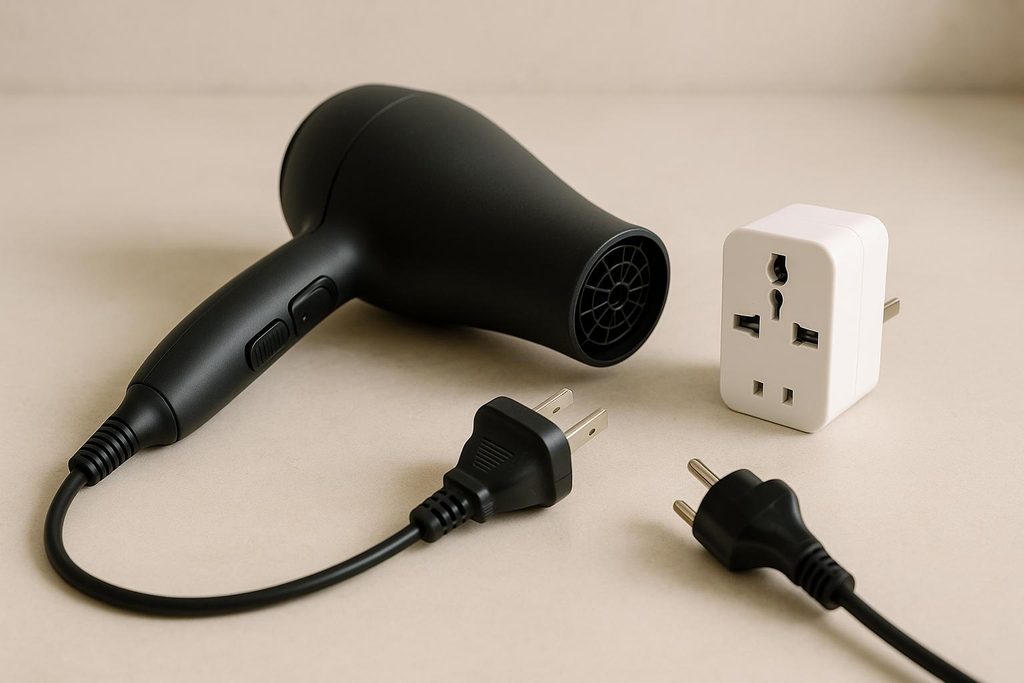
6. Voltage Compatibility Is Not the Same as Plug Compatibility
Another common misunderstanding is that a dual-voltage product can automatically be used in every country.
Voltage compatibility and plug compatibility are two separate considerations.
A product may support both 110V and 220–240V input supplies but still require a destination-specific power plug.
Buyers should consider:
Plug type
Different markets use different plug configurations. The product may require a customized plug or cord assembly.
Frequency
Electrical frequency can affect certain motor and control designs. Confirm whether the product supports the destination market’s frequency.
Rated power
A product’s power consumption and performance should be evaluated under each supported voltage configuration.
Electrical safety requirements
The appliance must meet the applicable electrical safety and conformity requirements for its destination market.
A simple travel plug adapter changes the physical plug connection. It does not convert electrical voltage.
This distinction should be clearly communicated to distributors and end customers.
7. What Should OEM Buyers Check During Product Testing?
Before approving a dual voltage hair styling appliance, buyers should request testing under each specified input voltage condition.
The evaluation may include:
Input voltage verification
Confirm that the product operates within its documented voltage range.
Power consumption
Measure operating power under the agreed test conditions.
Heating performance
Check heating time, temperature stability and temperature control behavior.
Motor performance
For motor-driven appliances, evaluate operating stability and airflow performance.
Protection functions
Review over-temperature protection and other relevant electrical safety functions.
Extended operation
Evaluate product behavior during an agreed operating period.
Plug and cord assembly
Confirm that the power cord, plug and strain relief are suitable for the intended market configuration.
Testing should follow the applicable product standards and an agreed quality plan. Buyers should request actual test records rather than relying only on general compatibility claims.
8. OEM and ODM Customization for Global Markets
For beauty brands selling in several countries, customization can help create a consistent product portfolio while meeting different regional requirements.
Depending on the product platform, an experienced manufacturer may support:
Electrical configuration
- Single-voltage versions
- Dual-voltage configurations
- Market-specific power cords
- Plug customization
- Frequency compatibility evaluation
Product appearance
- Customized housing colors
- Surface finishes
- Logo placement
- Product structure adjustments
Functional configuration
- Temperature settings
- Speed settings
- Control interface
- Selected product features
- Accessory configurations
Branding and packaging
- Private label branding
- Customized retail boxes
- Multilingual manuals
- Market-specific product labels
- Barcode and packaging artwork
All electrical and functional configurations should be confirmed through engineering review and sample testing before mass production.
9. Questions to Ask a Dual Voltage Hair Tool Manufacturer
Before choosing an OEM or ODM supplier, buyers should ask:
- Does the selected product support single voltage or dual voltage?
- What exact input voltage range is supported?
- Does the product support 50Hz and 60Hz?
- Is voltage switching automatic or manual?
- Does rated power change between voltage configurations?
- Can the manufacturer customize plugs for different countries?
- Are electrical safety reports available for the selected configuration?
- Can the supplier provide samples for both voltage conditions?
- What OEM/ODM customization options are available?
- What is the MOQ and production lead time for customized versions?
These questions help reduce the risk of ordering products that are unsuitable for the intended market.
10. Final Checklist Before Placing an International Bulk Order
Before confirming a dual voltage hair styling appliance order, buyers should verify:
- Destination markets have been identified.
- Required input voltage ranges are confirmed.
- Frequency compatibility has been checked.
- Automatic or manual switching has been confirmed.
- Rated power has been reviewed.
- Plug types and power cords are approved.
- Heating and motor performance have been evaluated.
- Electrical protection functions have been tested.
- Applicable market certification requirements are confirmed.
- Product labels and user manuals are approved.
- Samples have been evaluated under the specified voltage conditions.
- The approved electrical configuration is documented for mass production.
A clear technical approval process helps international buyers avoid compatibility problems and improve product consistency across different markets.
Why Work with an Experienced Hair Styling Tool Manufacturer?
Developing hair styling appliances for international markets requires more than changing a power plug.
The electrical architecture, motor system, heating components, control circuit, safety protection and manufacturing process must work together to meet the intended market requirements.
At Aikepro, we provide OEM and ODM manufacturing solutions for overseas beauty brands, wholesalers, importers and distributors.
Our product range includes:
- Professional hair dryers
- High-speed hair dryers
- Hot air brushes
- Multi-functional air stylers
- Hair straighteners
- Curling irons
- Hair clippers and trimmers
Depending on the selected product platform, we can discuss voltage configurations, plug customization, product colors, branding, accessories and packaging options.
Our team supports product development, sample evaluation and manufacturing coordination to help B2B customers develop products for their target markets.
Frequently Asked Questions
Q1: Can a dual voltage hair dryer work in both the United States and Europe?
It can, if its specified input voltage range includes the electrical supplies of both markets and its frequency and plug configuration are suitable. Always verify the actual product rating.
Q2: Does a dual voltage hair dryer need a voltage converter?
A properly specified dual-voltage appliance generally does not require an external voltage converter when connected to a compatible supply. A suitable plug adapter may still be required.
Q3: Is automatic voltage switching better than manual switching?
Automatic switching can make operation more convenient, but both approaches can be suitable when correctly engineered, clearly labeled and tested.
Q4: Can a high-speed hair dryer be designed with dual voltage?
This depends on the motor, power electronics, heating system and overall electrical architecture. The feasibility must be evaluated for the specific product platform.
Q5: Can OEM manufacturers customize voltage and plug types?
Depending on the product design and manufacturing capabilities, voltage configurations, power cords and destination-specific plugs may be customized.
Q6: What should buyers request before placing a bulk order?
Request the confirmed electrical specifications, applicable certification documents, sample test results, plug configuration, user instructions and an approved reference sample.
Looking for a Dual Voltage Hair Styling Tool Supplier?
If you are a beauty brand, importer, wholesaler or distributor planning to expand into international markets, Aikepro can discuss suitable hair styling appliance configurations and OEM/ODM solutions.
Tell us your target countries, voltage requirements, preferred product category and estimated order quantity.
Let’s develop the right hair styling solution for your global market.