
The professional barber equipment market continues to offer opportunities for beauty brands, distributors and wholesalers. Among the essential products in this category, professional hair clippers remain an important product for barbershops, salons and personal grooming businesses.
However, not all electric hair clippers deliver the same cutting experience.
Blade materials, motor performance, cutting speed, battery capacity, charging design and overall construction all influence product performance and customer satisfaction.
For brands planning to launch a private label hair clipper or expand an existing grooming product range, selecting the right manufacturer is just as important as choosing the product itself.
This guide explains the key factors to evaluate when sourcing professional hair clippers for wholesale and OEM/ODM projects.
1. Understand Different Types of Professional Hair Clippers
Before selecting a supplier, buyers should identify the type of clipper that best fits their target market.
Professional Cordless Hair Clippers
Cordless clippers operate using a rechargeable battery and offer flexibility during professional use.
Important evaluation points include:
- Battery capacity
- Operating time
- Charging time
- Charging interface
- Motor efficiency
- Cordless operating stability
These products are suitable for barbers who prefer unrestricted movement during haircuts.
Corded Hair Clippers
Corded models receive continuous power through a connected power supply.
They can be suitable for professional environments where extended operation is important.
Buyers should evaluate cord durability, electrical compatibility, motor stability and handling comfort.
Hair Trimmers
Hair trimmers are generally designed for detailed grooming, outlining, beard shaping and precision finishing.
Blade width, cutting accuracy, motor performance and ergonomic design are important selection factors.
A complete barber product portfolio may include both full-size clippers and precision trimmers.
2. Evaluate Blade Materials and Cutting Performance
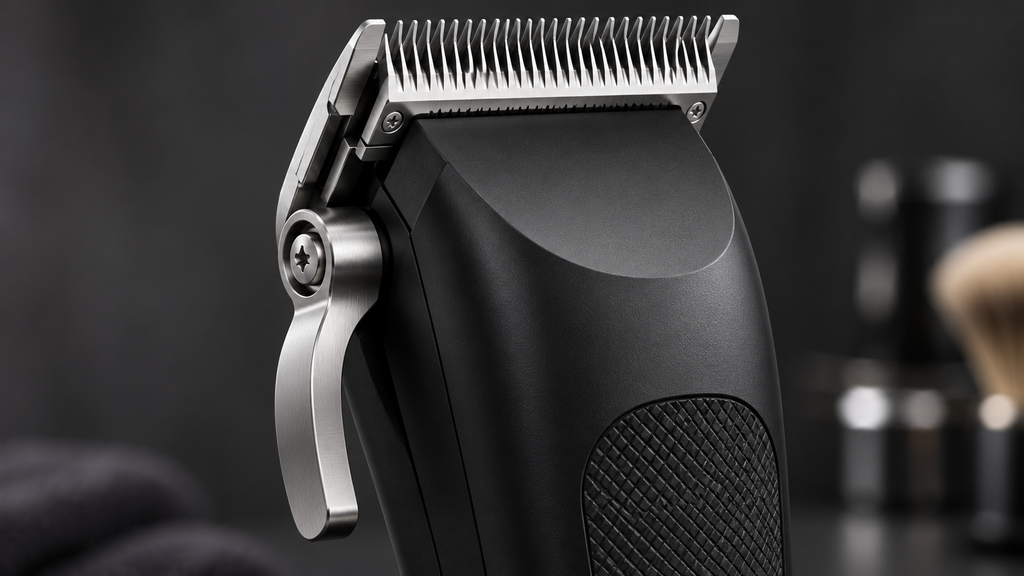
The blade is one of the most important components of a professional hair clipper.
Its material, manufacturing precision and finishing quality influence cutting performance and durability.
Common blade options include:
Stainless Steel Blades
Stainless steel is widely used in grooming appliances. It offers corrosion resistance and can be manufactured with different blade geometries and finishes.
Ceramic Blades
Ceramic cutting components are used in selected clipper designs. Their properties differ from metal blades, and their suitability depends on the product structure and application.
DLC-Coated Blades
Diamond-Like Carbon coatings can be used on selected blade surfaces to improve surface hardness and wear characteristics.
For OEM buyers, the coating specification, base material and actual performance should be confirmed with the manufacturer.
When evaluating samples, consider:
- Blade sharpness
- Cutting consistency
- Blade alignment
- Surface finishing
- Heat generation during operation
- Resistance to wear
- Ease of cleaning and maintenance
A professional hair clipper should deliver consistent cutting performance under the intended operating conditions.
3. Choose the Right Motor for Your Target Market
Motor performance directly influences the cutting experience.
A motor that is unsuitable for the blade structure or intended application may cause inconsistent cutting, excessive vibration or reduced efficiency.
Buyers should evaluate the following factors.
Motor speed
Different motor designs operate at different speeds. Higher RPM does not automatically guarantee better cutting performance.
Torque
Torque is important when the clipper needs to maintain cutting performance under different hair densities.
Operating stability
The motor should operate consistently without abnormal noise or excessive vibration.
Heat management
Continuous operation can generate heat. Buyers should evaluate motor temperature and overall thermal behavior during testing.
Motor durability
Long-term operating reliability should be evaluated using an agreed testing procedure.
For private label projects, motor selection should be matched with blade geometry, housing design and the intended customer segment.
4. Check Battery Capacity and Charging Performance
Battery performance is especially important for cordless hair clippers.
A product may have an attractive design and powerful motor, but insufficient battery performance can negatively affect the professional user experience.
Important specifications include:
| Battery Specification | What Buyers Should Evaluate |
|---|---|
| Battery Type | Lithium-ion or other approved battery chemistry |
| Capacity | Rated capacity in mAh or Wh |
| Operating Time | Runtime under defined test conditions |
| Charging Time | Time required for a full charge |
| Charging Interface | USB-C or other specified connection |
| Battery Protection | Overcharge, over-discharge and related protection |
| Battery Life | Performance after agreed charge cycles |
Buyers should request actual test conditions when comparing battery runtime claims.
For example, runtime may vary depending on motor speed, load, battery condition and operating temperature.
Battery capacity alone does not determine how long a clipper will operate.
5. Evaluate Blade Adjustment and Cutting Length Options
Professional barbers work with different hairstyles and cutting techniques.
For this reason, blade adjustment and cutting length options are important product considerations.
Depending on the model, clipper designs may include:
- Adjustable taper levers
- Interchangeable guide combs
- Different cutting length settings
- Zero-gap adjustment capability, where supported
- Replacement blade options
Buyers should confirm the available cutting length range and accessory configuration before selecting a product.
The adjustment mechanism should operate smoothly and maintain the intended blade position.
For OEM development, guide comb quantities, sizes, colors and packaging arrangements can be customized according to the project requirements.
6. Consider Ergonomics and Product Construction
A professional clipper may be held and operated repeatedly throughout the working day.
Its physical design therefore has a direct impact on user experience.
When evaluating samples, consider:
Weight distribution
The product should feel balanced in the hand.
Handle design
The housing should provide a comfortable and secure grip.
Button placement
Power switches and adjustment controls should be easy to access.
Housing materials
The materials should provide suitable strength, surface quality and durability.
Cleaning and maintenance
The blade assembly should be accessible for the maintenance procedures specified by the manufacturer.
Operating noise and vibration
Excessive vibration or abnormal noise may affect perceived quality.
These factors should be reviewed alongside technical specifications rather than treated as purely cosmetic details.
7. Check Charging, Display and Additional Functions
Modern professional hair clippers may include additional features that help differentiate a product in the market.
Depending on the design, these may include:
- LED battery indicators
- Digital displays
- Multiple motor speed settings
- USB charging
- Charging docks
- Travel locks
- Low-battery warnings
- Replaceable blade assemblies
Not every product needs every feature.
For premium barber brands, buyers may prioritize professional cutting performance and durability.
For retail grooming brands, display design, charging convenience and user-friendly controls may be more important.
The best configuration depends on the product positioning and target customers.
8. Evaluate Hair Clipper Quality Before Bulk Ordering
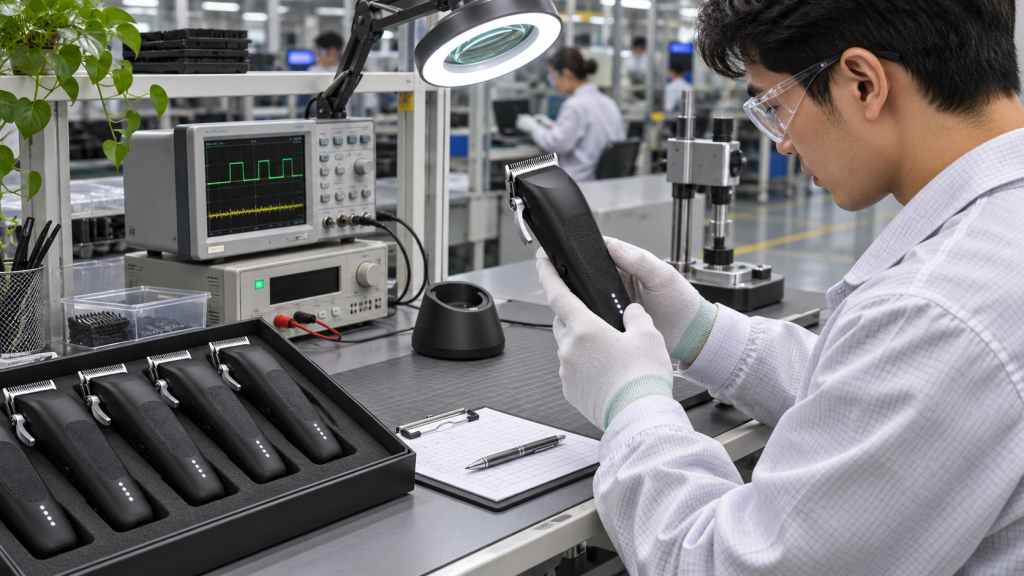
A professional sample should be evaluated under realistic operating conditions before mass production.
A structured testing plan may include:
Cutting performance testing
Evaluate cutting consistency on representative hair types and densities.
Blade inspection
Check blade alignment, surface finishing, sharpness and adjustment.
Motor testing
Evaluate speed stability, operating noise and vibration.
Battery testing
Measure charging time and operating duration under defined conditions.
Temperature testing
Monitor temperature during continuous operation.
Drop and structural testing
Evaluate housing and component integrity using agreed procedures.
Switch and control testing
Check button operation and mechanical durability.
Aging testing
Operate samples under defined conditions to identify potential early failures.
For B2B projects, testing criteria should be documented and agreed upon before mass production.
9. OEM and ODM Customization for Barber Brands
For companies building their own grooming brands, product customization is an important way to differentiate their product range.
An experienced OEM/ODM manufacturer may support customization in several areas.
Product Appearance
- Housing color
- Surface finish
- Logo placement
- Housing material
- Product shape, subject to engineering feasibility
Functional Configuration
- Motor selection
- Blade material and coating
- Battery capacity
- Charging configuration
- Display and indicator options
- Guide comb configuration
Branding and Packaging
- Private label logo
- Customized retail box
- User manuals
- Accessory packaging
- Product labels
- Market-specific documentation
Before starting a customized project, buyers should confirm the development schedule, sample approval process, tooling requirements and production specifications.
10. Questions to Ask a Hair Clipper Manufacturer
Before selecting a supplier, professional buyers should ask:
- What blade materials and coatings are available?
- What motor configurations can be supplied?
- How is cutting performance evaluated?
- What battery capacities are available?
- What is the measured operating time?
- What charging configurations are supported?
- Can cutting length and guide comb options be customized?
- What product aging and durability tests are conducted?
- Can the factory provide samples and test documentation?
- What are the MOQ and lead time for OEM production?
A supplier’s technical knowledge and ability to explain its manufacturing process can help buyers evaluate whether it is suitable for long-term cooperation.
11. Final Checklist Before Placing a Bulk Order
Before confirming a professional hair clipper order, buyers should review:
- Blade material and coating are approved.
- Cutting performance has been evaluated.
- Motor specifications are confirmed.
- Motor noise and vibration are acceptable.
- Battery capacity and runtime are verified.
- Charging configuration is approved.
- Cutting length and guide comb options are confirmed.
- Product ergonomics and housing quality are reviewed.
- Electrical safety requirements are confirmed.
- Market-specific certification requirements are reviewed.
- Packaging and accessories are approved.
- The final sample is retained as the mass production reference.
A clear approval process helps reduce quality risks and improve consistency across bulk orders.
Why Work with an Experienced Hair Clipper Manufacturer?
Developing a competitive professional hair clipper requires coordination between blade engineering, motor selection, battery systems, housing design, electronics and assembly.
At Aikepro, we provide hair styling appliance manufacturing and OEM/ODM solutions for overseas beauty brands, wholesalers, distributors and importers.
Our product range includes:
- Professional hair dryers
- Hair straighteners
- Curling irons
- Hot air brushes and multi-stylers
- Hair clippers and trimmers
Our manufacturing capabilities include:
- In-house mold and injection molding workshops
- Product appearance and structural customization
- Private label branding and packaging
- Sample development and engineering support
- Product inspection and quality control
- International market compliance support
We work with B2B partners to develop grooming products according to their target market, technical requirements and brand positioning.
Frequently Asked Questions
Q1: What is the most important factor when choosing a professional hair clipper?
Blade quality, motor performance and cutting consistency are among the most important factors. Battery performance and ergonomics are also important for cordless models.
Q2: Are DLC-coated blades suitable for professional hair clippers?
DLC coatings can improve certain surface properties, including hardness and wear resistance. Buyers should confirm the coating specification and evaluate actual cutting performance.
Q3: How long should a cordless hair clipper operate?
Operating time depends on battery capacity, motor design, operating speed and load. Buyers should compare measured runtime under consistent test conditions.
Q4: Can hair clippers be customized for private label brands?
Yes. Depending on the product platform, customization may include colors, logos, blade configurations, battery specifications, accessories and packaging.
Q5: Should buyers test samples before placing bulk orders?
Yes. Sample testing allows buyers to evaluate cutting performance, motor stability, battery operation, ergonomics and overall product quality before production approval.
Looking for a Professional Hair Clipper OEM/ODM Supplier?
If you are a barber brand, grooming product distributor, wholesaler or importer planning to develop your own hair clipper range, Aikepro can discuss suitable product configurations and manufacturing solutions.
Share your target market, preferred product specifications, estimated order quantity and customization requirements with our team.
Let’s develop your next professional grooming product together.